
Transitioning a loved one to memory care is never a simple decision. If you’re here, you’re likely feeling a mix of concern, uncertainty, and perhaps even guilt. You may be wondering: Is it too soon? Too late? Am I doing the right thing?
To help guide you through this difficult time, we spoke with Kevin Defayette, Regional Director of Operations, who has supported countless families through the transition into memory care.
“One of the hardest parts for families and caregivers is realizing that love alone can’t replace specialized care,” Kevin says. “We need to reframe this realization – that it might be time for memory care – as an act of compassion rather than a failure.”

Kevin DeFayette
Regional Director of Operations
With years of experience guiding families through these transitions to memory care at our Bridges Hingham community, Kevin now lends his support and guidance to several of our Bridges communities.
What are the biggest signs it’s time to transition to memory care?
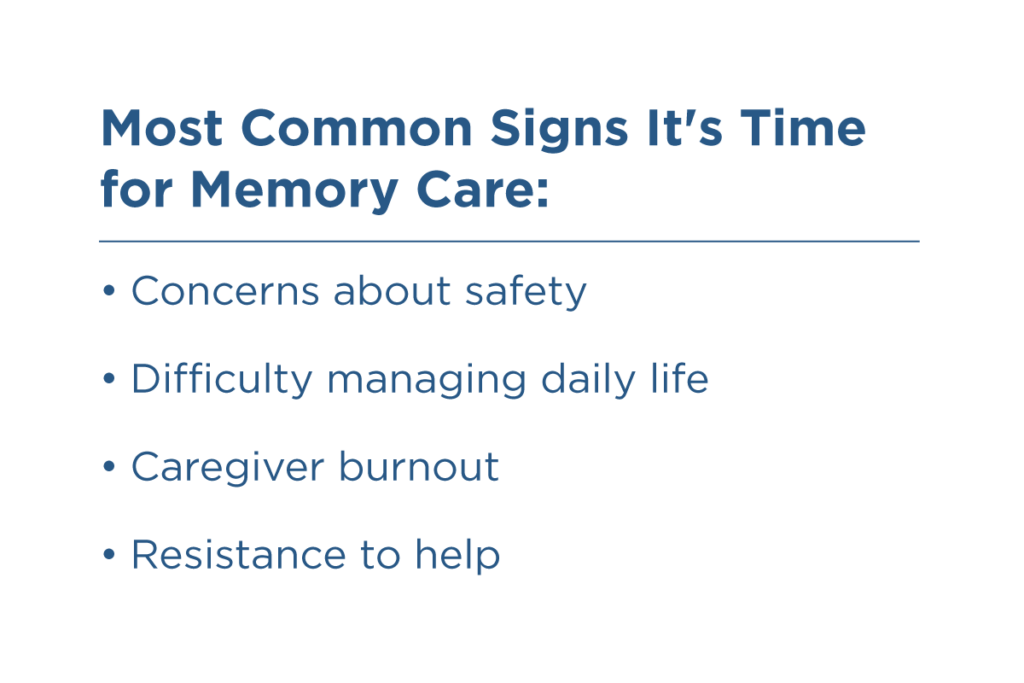
The most common signs it’s time for memory care include increased safety risks, an inability to manage daily life at home, and overwhelming caregiver stress.
Kevin has seen families reach a tipping point when everyday life becomes unpredictable or unsafe, even with supportive measures in place. Consistent red flags often include:
- Wandering or getting lost, even in familiar places
- Forgetting to turn off the stove or other appliances
- Frequent falls or unexplained injuries
- Difficulty bathing, dressing, eating, or using the bathroom independently
- Increasing confusion, agitation, or anxiety
- Resistance to in-home caregivers or outside help
- Caregiver burnout, exhaustion, or declining health
“One of the clearest signs for families is when, despite their best efforts, home simply isn’t the safest or most supportive environment anymore.”
Kevin Defayette, Regional Director of Operations
Is a dementia diagnosis a reason to consider memory care?
A dementia diagnosis is an important signal to begin the conversation and start planning, even if an immediate move isn’t necessary.
In the earliest stages, many individuals can still live at home with support. But dementia is progressive, and planning early gives caregivers time to explore options thoughtfully rather than having to react to a crisis.
A diagnosis allows families to:
- Learn about the type and progression of dementia
- Understand what care will look like in the future
- Visit memory care communities before an urgent need arises
- Involve their loved one in decisions, when appropriate
“Too often, families wait until something goes wrong. A rushed decision after an emergency is far more traumatic than a proactive, planned transition.”
How do I know if home is no longer safe for my loved one?
Home is no longer a safe environment when your loved one can’t complete basic daily tasks or recognize common dangers.
Dementia affects judgment, awareness, balance, reasoning, and perception. This can make once-simple tasks risky.
Home safety concerns may include:
- Leaving doors unlocked or wandering outside
- Misusing medications or forgetting dosages
- Turning on water or appliances and walking away
- Inability to recognize stairs, clutter, or hazards
- Difficulty calling for help in emergencies
Many caregivers try to adapt the home with locks, alarms, or cameras. While these can help temporarily, Kevin notes:
“Adaptations are a great way to try to make the home safer, but they can’t replace 24/7 specialized care, supervision, and structure. At a certain point, staying at home becomes dangerous.“
What happens when a caregiver starts to burn out?
Caregiver burnout is one of the clearest and most overlooked indicators that memory care may be the best course of action.
We often only look at whether the individual with dementia needs memory care. Sometimes, observing the caregiver can give important clues.
Most caregivers are spouses or adult children juggling:
- Full-time jobs
- Children and family obligations
- Their own physical and mental health
Over time, this leads to:
- Chronic exhaustion
- Depression or anxiety
- Irritability or resentment
- Weakened immune function
- Social isolation
“It is not possible to provide quality care if you are completely drained,” Kevin says. “And that doesn’t make someone a bad caregiver.”
One of the greatest benefits loved ones experience with memory care is the chance to return to being a son, daughter, or spouse again, rather than a full-time medical provider.
Check out our podcasts for further advice. In a recent episode, our team discussed the need to reduce caregiver stress.
Should I trust my instincts about memory care?
If your heart is telling you that something has to change, it’s worth listening to that intuition.
Caregivers live in a state of “what if” for far too long:
- What if they get worse?
- What if I’m overreacting?
- What if they hate it there?
Now, try asking:
What if they would be safer, calmer, and more supported in memory care?
Time and again, caregivers look back and say:
- “I wish we had done this sooner.”
- “They’re more peaceful now.”
- “We finally have support.”
Sometimes, you have to trust your gut; it’s valuable information if you are uncomfortable about the direction things are heading.
Listen: When Is Memory Care Assisted Living Appropriate? (with Alicia Seaver)
If your instincts are telling you it may be time, that feeling is worth listening to. In this episode of our EPOCH Exchange podcast, Alicia Seaver, VP of Memory and Brain Health at Bridges, talks through what “the right time” for memory care can look like, the common turning points families notice, and how to move forward without guilt. Listen/watch below:
How is memory care different from assisted living?
Memory care is designed specifically for people living with Alzheimer’s disease and other forms of dementia, while assisted living is not.
Assisted living communities typically support older adults who need some help with daily tasks such as bathing, dressing, or managing medications, but who can still make many decisions on their own. They aren’t built to support progressive cognitive decline, nor do they provide the level of structure, supervision, or training required for dementia care.
Memory care communities like Bridges are different in several key ways:
- Higher team member-to-resident ratios to allow for closer supervision and support
- Specialized dementia education for every team member
- Secured environments that prevent unsafe wandering
- Purposefully designed spaces that reduce confusion and overstimulation
- Daily routines and programming created for individuals with cognitive impairment
Check out our guide comparing memory care to assisted living and home care.
“At Bridges®, everything is intentionally built around dementia,” Kevin explains. “From the layout of the community to the way our team communicates, the entire experience is centered on helping residents feel safe, calm, and engaged.”
What are caregivers really gaining from memory care?
Caregivers gain safety, stability, professional support, and emotional relief when a loved one moves to memory care.
While cost is often one of the first concerns, caregivers usually find that what they receive goes far beyond physical care. Memory care provides around-the-clock supervision, structured routines, and a care team that truly understands dementia.
Many caregivers also notice changes soon after the move, including:
- Fewer episodes of agitation or distress
- More consistent sleep and eating patterns
- Increased engagement in daily life
- Reduced risk of injury
- Fewer ’emergency’ situations
For caregivers, the biggest shift is often internal. The constant pressure of decision-making, monitoring, and managing risk begins to ease.
In its place, there is space to reconnect with a spouse, parent, or loved one on a human level.
“Memory care gives families back their relationship,” Kevin says. “They no longer have to spend every moment worrying about safety or medication schedules. They can focus on being present instead.”
How do I cope with the guilt and grief of this decision?
Feeling guilt or grief is a normal part of this transition, even when you know you are making a responsible and loving choice.
Many people see the move to memory care as “giving up” or “losing” the person they once knew. Others worry they waited too long or not long enough. These thoughts are common, but they often come from a place of grief rather than reality.
Kevin encourages caregivers to reframe the decision:
“You aren’t taking something away from your loved one. You are giving them more support, more safety, and more consistency than you could ever provide alone.”
Support can make this process more manageable. At Bridges®, families can connect with others who are facing similar decisions through support groups, education sessions, and one-on-one conversations. Knowing you are not alone can take some of the emotional weight off your shoulders.
It also helps to remember that dementia is a progression. You did not cause this change, and you cannot reverse it through sheer determination. What you can do is choose a path that keeps your loved one protected and cared for.
What actually happens after someone moves into memory care?
Most people adjust more smoothly than families expect, especially when the move is planned ahead of time.
There is often fear that a loved one will feel abandoned or confused in a new environment. While every person is different, Kevin notes that the opposite is usually true.
He has seen caregivers brace for the worst and then be amazed at how their loved one settles in. He attributes this to the fact that residents are supported in ways that simply aren’t possible at home or in a hospital-like setting.
Routine is critical. Residents also truly benefit from enriching activities that embrace art and music therapy. Regular movement and daily social connection also make a difference, such as encountering neighbors and conversing with team members each day. These things remain present even as dementia progresses.
Can my loved one age in place in a memory care community?
Yes, Bridges® communities are equipped to support residents through every stage of dementia progression.
One of the most comforting aspects of memory care is the ability for a resident to stay in the same familiar environment as their needs change. Frequent moves between care settings can be disorienting and distressing for a person living with dementia (and you!).
At Bridges®, residents can age in place through programs designed to adapt to increasing physical and cognitive needs. As care requirements grow, we can adjust services so residents can remain in a familiar and comforting space surrounded by a team that knows them well.
If your loved one needs more advanced support, additional care options, such as Enriched Care, may be available within the same community.
This continuity is reassuring if you are concerned about repeated transitions.
How can I make the transition into memory care easier?

A thoughtful and familiar approach can reduce anxiety and help your loved one feel more comfortable with the change.
Even when memory care is clearly the right next step, the actual move can be emotional and confusing for a person living with dementia. Planning ahead and taking small steps can make the transition gentler for everyone involved.
Helpful ways to prepare include:
- Visiting the community several times before move-in so the space becomes more familiar
- Introducing your loved one to team members in advance
- Talking with the team about your loved one’s routines, preferences, and sensitivities (we have a form to collect some specifics)
- Planning the room layout carefully so it feels as much like home as possible
Bringing familiar objects, photos, blankets, or a favorite chair can provide a sense of comfort and recognition in a new environment. Even when short-term memory is limited, emotional memory is often still present. What feels familiar can still feel safe.
How can I support my loved one before and after the move?
Support continues long after move-in and plays an important role in emotional well-being.
On the first day, it often helps to spend some time together in the community. Your presence can offer reassurance, even if your loved one does not fully understand the situation.
In the days that follow, visiting regularly can strengthen your connection and help the new routine feel normal.
At the same time, it is helpful to follow the care team’s guidance. In some cases, short breaks between visits make it easier for residents to settle into a consistent routine. Every individual is different, and the team can help determine what approach is best.
Read our guide on how and when to visit your loved one.
Over time, you will begin to recognize the natural rhythm of community life, including the best times and environments for visits. Many families eventually find comfort in becoming more involved, whether that means attending events, sharing meals, or getting to know other residents and families.
How does Bridges® by EPOCH support loved ones through this journey?
At Bridges®, care extends to loved ones, not just the resident.
While the primary focus is always the individual living with memory loss, Bridges® recognizes the impact dementia has on everyone involved. We support loved ones through consistent communication, education, and connection with others who understand the journey.
Support includes:
- Regular updates and open communication with care teams
- In-person and virtual support groups for families and caregivers
- Educational sessions led by memory care professionals
- Opportunities to connect with other families who have faced similar decisions
Kevin explains, “This isn’t something families have to navigate alone. Whether they are still deciding or have already taken the step into memory care, we are here as a partner.”

Take a look at our upcoming caregiver support groups
Read more about moving into memory care:

What should I do next if I think it might be time?
The best next step is to have a conversation and gather information, even if you are not ready to act immediately.
You don’t have to make a final decision today. What you can do is ask questions, explore your options, and learn what support looks like beyond home.
Consider starting with:
- Talking with your family and primary care physician
- Scheduling a tour at a memory care community
- Speaking with a senior living advisor or Bridges® team member
- Attending an educational session or support group
Sometimes, the simple act of visiting a community and seeing the environment in person brings clarity. You can better envision your loved one’s life there. You can ask real, specific questions.
If you are ready to explore memory care, the Bridges® by EPOCH team is here to listen, offer insight, and support you in every step of the decision-making process. Fill out our form below, and a team member will be in touch.