
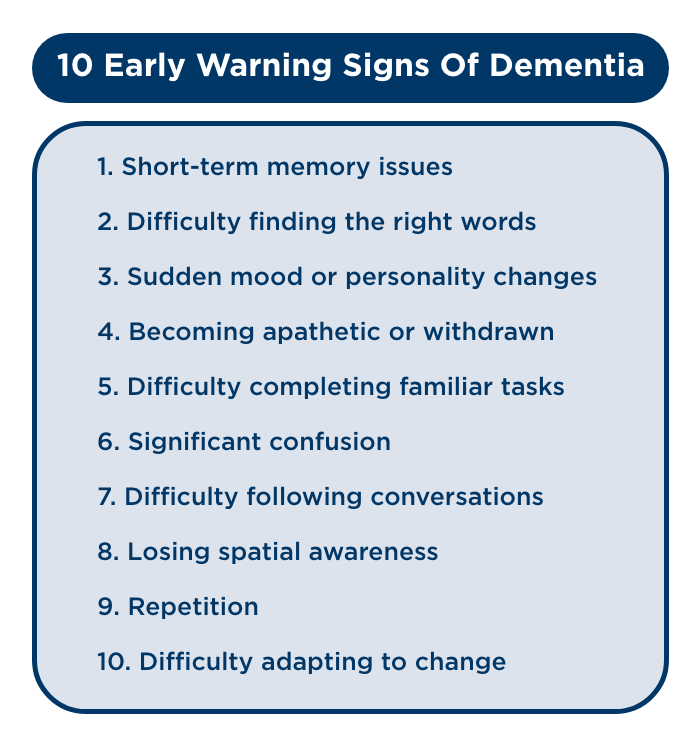
- Short-term memory issues
- Difficulty finding the right words
- Sudden mood or personality changes
- Becoming apathetic or withdrawn
- Difficulty completing familiar tasks
- Significant confusion
- Difficulty following conversations
- Losing spatial awareness
- Repetition
- Difficulty adapting to change
- When signs go beyond normal aging

As we get older, our bodies and overall health naturally change. We may move a bit slower, as we feel aches and pains that were not there before. These are some of the usual effects of aging. While that is normal, persistent memory loss and cognitive decline are not considered a normal part of aging.
When we or a loved one start showing signs of memory trouble, families often react in one of two ways: they immediately assume it must be dementia, or they brush it aside and hope it goes away. Neither response is ideal.
Occasional forgetfulness does not automatically mean a person has dementia. Misplacing keys once in a while or forgetting part of a recent conversation can happen for many reasons. What matters is whether symptoms are becoming more frequent, affecting daily life, or appearing alongside other changes in thinking, language, mood, judgment, or behavior.
Alicia Seaver, VP of Memory Care Operations, Bridges by EPOCH
Dementia affects more than memory alone. Conditions such as Alzheimer’s disease, Lewy body dementia, and other forms of cognitive impairment can also affect communication, reasoning, focus, behavior, and the ability to manage everyday tasks.
In many cases, a doctor will look for impairment in at least two areas of cognitive function before making a diagnosis.
If you are concerned about your own cognitive health or that of a loved one, here are 10 early warning signs of dementia to watch for.
1. Short-term memory issues
The most common and visible symptom of dementia is memory trouble. Often, these changes begin subtly and affect short-term memory more than long-term memory. For example, your mother may remember every detail of the house she grew up in, but not what she bought at the grocery store that morning.
Memory problems can also show up as forgetting schedules, misplacing everyday items, not remembering where someone is, or not being able to recall how they arrived somewhere.
2. Difficulty finding the right words
Many forms of dementia affect communication and language early on. A person may struggle to find the right words or lose their train of thought. They may have trouble expressing what they mean during a conversation.
They may substitute the wrong word or pause for a long time. Generally, they speak in a way that feels more fragmented than before.
Over time, conversations may become increasingly difficult or frustrating for you as the listener, but also for the person trying to make themselves understood. Families may find it helpful to learn effective communication tips for dementia caregivers.
3. Sudden mood or personality changes
If your usually upbeat dad suddenly becomes withdrawn and irritable, or your socially active mother becomes fearful about leaving the house, it may be worth paying attention.
Changes in mood or personality can be an early sign of dementia, though they can also have other causes, including medication side effects, depression, anxiety, or other health concerns.
That is why a medical evaluation is important when these changes are new and particularly noticeable, or out of character.
4. Becoming apathetic or withdrawn
It is common for someone with early dementia to lose interest in hobbies and activities they once enjoyed. They may become more isolated or less motivated to participate in everyday routines.
Sometimes this can look like apathy or listlessness, and sometimes it can progress to something resembling depression. These changes should be discussed with a physician, especially if they are persistent.
5. Difficulty completing familiar tasks
If your mom suddenly forgets how to make a recipe she has been baking for fifty years, it may be a sign that something more serious is going on.
Alicia Seaver, VP of Memory Care Operations
Tasks such as balancing a checkbook, using the washing machine, following a familiar card game, or preparing a regular meal can become harder for someone with dementia.
What once felt automatic may begin to require much more effort, or may no longer be possible without help.
6. Significant confusion
Occasional confusion can happen to anyone. Forgetting where your glasses are or walking into a room and forgetting why you are there is not unusual.
More concerning confusion is different. If your loved one is regularly forgetting what day or month it is, becoming confused about where they are, failing to recognize familiar faces, or showing poor judgment in ways that are unusual for them, that may point to something more serious.
Confusion can be a sign of dementia, but it can also be caused by other medical issues, including dehydration, infections, medication side effects, or sudden illness.
When confusion is new or worsening, you should look to get a medical evaluation to pinpoint the underlying reason. If symptoms seem to change very quickly, you may also want to read more about whether dementia symptoms can worsen overnight.
7. Difficulty following conversations or complex thinking
Dementia can make it harder to follow conversations, storylines, instructions, or situations with multiple steps. A person may become easily confused in group settings, while watching television, or when trying to follow a discussion that once would have felt simple.
This happens as a brain dealing with dementia has a hard time separating the different ways it is being stimulated, resulting in a kind of cognitive overload.
This can lead to frustration, anxiety, and withdrawal, especially in busy or overstimulating environments.
8. Losing spatial awareness and sense of direction
Changes in spatial awareness can be one of the early signs of dementia. A person may become clumsier, misjudge distance, shuffle more when walking, or have trouble navigating spaces that once felt familiar.
They may also start to lose their sense of direction. For example, they may forget how to get to a familiar grocery store, fail to recognize landmarks, or become confused in a parking lot, neighborhood, or public building they have visited many times before. Even when directions are explained clearly, following them may become difficult.
9. Repetition
Repetition is common in dementia because short-term memory loss can make a person forget that they have just asked a question, completed a task, or said something moments earlier.
A person may repeat the same question again and again, tell the same story several times in a short period, or repeat a word or phrase. While repetition can happen for other reasons, too, frequent repetition paired with other cognitive changes may be a sign that you need to seek a medical evaluation.
10. Difficulty adapting to change
For someone in the early stages of dementia, the world can begin to feel confusing and unpredictable. This makes sense; the changes they are experiencing are scary. They may have trouble remembering where they are going, understanding what others are saying, or adjusting when something about their usual routine changes.
That is one reason many people with early dementia cling to routine. They may become upset by schedule changes, new places, unfamiliar people, or activities that fall outside what feels known and safe. What looks like stubbornness may actually be anxiety caused by growing cognitive difficulty.
When our brain chemistry is changing, it is a fearful experience. It is a very natural, human response to become resistant to change.
Alicia Seaver, VP of Memory Care Operations
When do these signs go beyond normal aging?
One of the hardest parts for loved ones is knowing when ordinary forgetfulness becomes something more.
Normal aging may involve slower recall and occasional forgetfulness. An elderly relative may need more reminders than before.
Dementia is more concerning when symptoms are persistent and progressive, and they begin to interfere with daily life or compromise safety.
When memory loss appears alongside confusion, language changes, poor judgment, getting lost, or changes in mood and behavior, it’s time to look more closely.
You can also learn more about how dementia affects the brain and behaviors and the stages of dementia and Alzheimer’s.
What to do if you notice early signs of dementia
If your loved one is showing one or more of these symptoms, or if something simply feels different, then trust your instinct. It’s important to schedule a medical evaluation.
There are many causes of memory and behavior changes besides dementia, including medication effects, sleep problems, vitamin deficiencies, depression, thyroid issues, infections, and other health conditions that may be treatable or reversible.
Getting checked sooner rather than later can help rule out those causes and, if dementia is present, allow your loved one to get the support they need as early as possible.
It can help to keep a written list of the changes you have noticed before the appointment. Note when symptoms began and how often they happen. Explain how they are affecting safety, communication, or daily routines.
Below is a video in which one of our dementia care experts, Camille Ciarametaro, Senior Advisor at Bridges Lexington, discusses the benefits of early detection:
Supporting quality of life after a diagnosis
Although Alzheimer’s disease and other forms of dementia are not yet curable, early recognition can still make a meaningful difference. A timely diagnosis helps you plan and access support earlier in the journey. The other benefit is that you avoid waiting for a stressful crisis that incites necessary action later on.
At Bridges® by EPOCH, we’re committed to helping families understand dementia and the care options available to them. In addition to memory care services, we offer educational resources and support for caregivers and loved ones navigating the challenges of cognitive decline.
To learn more, explore our resource center or fill out the form below to contact our team.