
Listen/watch our EPOCH Exchange podcast episode below.
Released May 2026 | Duration: 29:12
Erica and Sarah from EPOCH Senior Living discuss Lowell General Hospital’s dementia-friendly care program, including ways to honor resistance, reduce restraints, and support patients with dementia. Myra Dionido-Magat and Megan Campagnone, clinical leaders at the MS2 unit, explain the innovative approaches they are bringing to the hospital setting.
We discuss:
- How Lowell General Hospital’s dementia-friendly MS2 unit began, and why acute care settings often need a different approach for patients living with dementia.
- Why resistance and refusals are often a form of communication, and how care teams can respond with patience, choice, validation, and trust-building.
- The role of “About Me” forms in helping hospital staff understand a patient’s routines, preferences, history, and comfort needs beyond the clinical diagnosis.
- How small moments of normalcy, like trips to Dunkin’ Donuts, can support dignity, connection, cooperation with care, and improved outcomes.
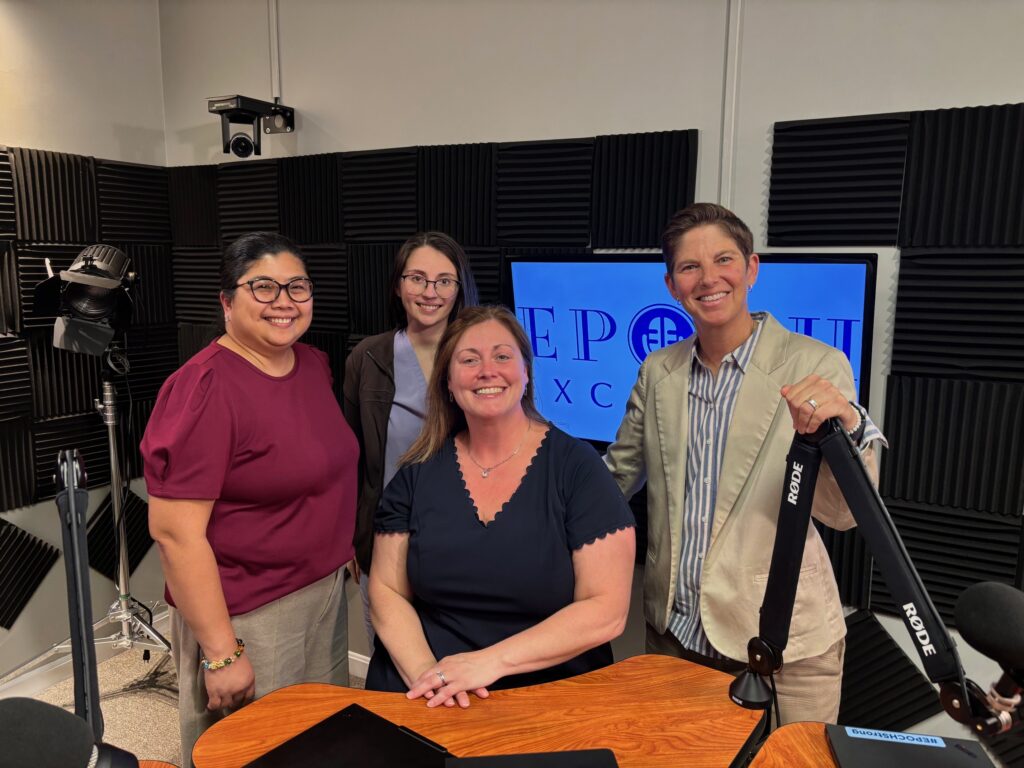
Guests:
Myra Dionido-Magat and Megan Campagnone
Clinical Leaders at Lowell Hospital’s dementia-friendly MS2 unit
Episode Transcript
Welcome to the EPOCH Exchange, where we get real about senior living, dementia care, and everything happening in senior life today. I’m Erica Labb, Director of Team Engagement and Culture for EPOCH Senior Living.
And I’m Sarah Turcotte, Area Community Liaison for our Bridges by EPOCH and Waterstone communities. Whether you’re a caregiver, a professional, or navigating memory loss yourself or with someone you love, you’re in the right place. We’re here to share real experiences, practical insight, and the conversations that don’t always happen, but should.
Each episode, we sit down with people who are making a real difference, from care team members to clinical experts and community leaders, bringing you a closer look at what’s happening every day in senior care and senior life. And our goal is simple. We want you to feel more informed, supported, and a little less alone along the way.
Today, we’re excited to share some updates on dementia-friendly initiatives happening at one of our local hospitals, and how their approach really helps when it comes to honoring resistance and refusals, something that often comes up when caring for someone living with dementia. It’s not always easy, and it’s something many families are navigating every day. Joining us today are two incredible nurses from Lowell General Hospital, a Tufts Medicine-affiliated hospital.
They’ve been leading some really meaningful work, bringing new programs and thoughtful approaches into the emergency setting that are making a real difference in how care is delivered to the patients living with dementia. And it is truly, truly a joy and pleasure to introduce two incredibly talented nurses that we work with here, Myra Dionido-Magat and Megan Campagnone. Myra is the clinical manager of D4, a cardiac step-down unit, and MS2, a dementia-friendly medical-surgical unit at Lowell General Hospital.
She has been with the organization for over 20 years. Truly incredible. Not to date you or anything. I know. She doesn’t look it. I don’t know how she’s been there for 20 years. But she grew from a staff nurse into a leadership role that she still holds today. She is incredibly passionate about supporting her team, focusing on mentorship, growth, and creating an environment where her staff feel confident, valued, and empowered to deliver exceptional care.
And working closely alongside of her is Meg, Megan, and Meg is a clinical leader on the MS2 unit. She has been with the hospital for five years and stepped into this role about a year ago. In that time, she’s made a meaningful impact supporting the team day to day, helping with staffing, leading quality improvement efforts, and playing a key role in advancing the unit’s dementia-friendly approach to care.
And we’re really, truly excited to highlight the dementia-friendly initiatives and the meaningful difference both of you are making in caring for patients living with dementia, particularly in how your team approaches and honors moments of resistance and refusals. Myra and Megan, welcome to the show.
Thank you for having us.
Thank you.
Thanks for having us.
Great to have you.
We want to hear more about the work, so if you could share more about how the dementia-friendly MS2 unit started, and explain to our audience the concept your approach.
So, our dementia-friendly program, we launched it in June of 2024. It is because we have seen a lot of patients that are staying for more than what they’re supposed to be staying in an acute care setting. I have two units, as Sarah mentioned. D4 is a very fast-paced environment, because it’s more cardiac-focused.
And then when they give me MS2, which is a different floor, it’s a medical-surgical floor. And when I do my rounds in the morning, I’ve noticed and seen patients that are on the same bed, same room, day after day, week after week, and then some of them are there for months or a year. The longest staying patient was 400 days.
Oh my gosh.
So in my head, we need to do something for these patients.
And the organization is very supportive of us, and they’ve been telling us, “Consider yourself the CEO of your units.”
Love that.
So, as the CEO of your unit, what can I do to improve the care for these patients? Because if you think about it, the dementia diagnosis or Alzheimer’s is not a diagnosis that is being admitted to an acute care hospital. They are there for a medical reason. So dementia is secondary. It’s not a primary diagnosis for any admission.
Yeah.
So we take care of the patients because of their medical issues. But with the pandemic and all that, these are the times when the patient comes to the hospital, and then the family, if they’re involved, realizes they cannot really take care of them at home anymore.
And then there are a lot of challenges finding beds for this patient. And if the family’s not involved, then we have to go for guardianship, which takes so long sometimes. So the patient –
Especially in that setting.
Right. So now the patient stays for months, because we have to wait for those uncontrollable circumstances. And if you look at the research, any patients, or majority of the patients with dementia or Alzheimer’s, when they come to the hospital, they deteriorate cognitively, physically, because acute care hospital is really not designed to take care of long-term patients –
Mm-hmm
Because we’re in acute care. So, we take care of the medical issues. Once you’re stable, your medical issues are resolved, we move you to a safe discharge, be it rehab or home with services or long-term care. So the acute care is not designed for an extended stay.
And yet you have people there for a long time.
I can see how it can be difficult
Yeah. So we have to do something for these patients.
Kudos to your leadership, also. I have to say kudos to your leadership to have you innovate like that and give you-
Yeah to empower you-
Yeah to innovate, to see a problem, and then innovate a solution. I love that. Being in team engagement and culture like that is-
Yeah amazing. So kudos.
Thank you. So, family is very important to me. I came from the Philippines. We’re a very close-knit family. That’s our core value. So I actually created this program because my dad had dementia, my grandparents had dementia, and I’m thousands of miles away from them, so this is my way of caring for them. And in some way, because I’m not able to care for them, there’s a guilt behind it. So, my purpose is to change that guilt into a positive. An action. Do something.
And I can imagine, as you’re sharing this story, when a patient with dementia is stuck at the hospital for this prolonged period of time, they want to go home. I’m sure that providing care or trying to keep that person’s day-to-day as normal as possible-
Yeah can be really difficult.
Can you just share some of the approaches that you’re utilizing with this program that kind of help with that?
So, I think one of the biggest things that we do is what we call an About Me form. So when we have a patient come in with dementia, we give a form to the family members, and they’re able to fill it out about what their routines are, what they like, what they don’t like, so that way, we can get a sense of what they enjoy outside of the hospital.
Is that new to this program?
It’s newer since we implemented the program.
Great. That’s great.
So we started it two years ago, and we’ve been continuing it forward.
That’s fabulous because on the Bridges side, we would send them. If someone was going to the ER, we’d send them that form whether they wanted it or not. So I love that not only do you request a form like that, but you actually utilize it.
Yes. It’s very helpful. Well, because it’s a per- Yeah a personal intake.
So important. It’s a personal intake. It’s not just a clinical scope. A clinical lens is important, but when someone is stuck there for as long as you’re saying, having this personal kind of information goes a long way. It’s more about the patient than just why they’re at the hospital. Right. And I think our staff especially likes to know more about the patient. What they do growing up. How can we highlight that for when they are escalating into a different behavior?
Absolutely. And can you share more about a few of the systems that are in place that are helping you with this? I just think of so many approaches that you’re doing.
So, our dementia program actually has seven key components. One is the creation of a safe, dedicated space, which we call the activity room. So, we have criteria because not everyone can go there, because we have to make sure that the patient and our staff are safe. So if they have any behavioral issues or communicable disease and whatnot, they’re not eligible to go to the space. And, aside from that, we also enhance identification of these patients.
So the whole care team, not just for the MSU staff, knows, and they can identify the patients with dementia. So when they approach these patients, they are very mindful that it’s not like a regular patient. You have to be mindful of approaching them in front of them, talking, be mindful of the tone of your voice and not-
And your body language.
Yeah. So we’re utilizing the Purple Angel signage. We have the purple bracelets. So if the patient goes to testing or procedures, people will know from the hospital or the care team that this patient has dementia. That’s great. Yep. So we thoughtfully change or modify our staffing matrix because traditionally, for a med surge unit, the night staffing is reduced as compared to the days and the evenings. And since we started our program, right now we’re looking at 30 to 60% on a daily census has a patient with dementia or cognitive impairment.
And we know sometimes those behavioral changes happens on the off shift, where your staffing is reduced. So my team decided that instead of increasing the nursing number for the night shift, they wanted the ancillary staff, so we have more support. And with that, we also created a new position, which is an activity coordinator. So we are going to be able to cognitively and physically stimulate them in the mornings, and that position has been expanded to cover seven days a week.
Wow.
Isn’t that incredible?
That’s amazing. Wow. Yeah, so- It’s like un- unheard of, I think.
Right?
Right. Like, I don’t know of any program like that. It’s one of the first. Wow. Congrats. That’s amazing.
So, and we also, because like, as I said earlier, dementia is not a primary diagnosis when you get admitted to the hospital, so that’s one of the barriers and the challenge that we faced.
Meg here had to manually track all of the patients admitted to our floor, and then identify who has dementia or cognitive impairment, so we can do early intervention, so we don’t have to use a lot of restraints for those patients. And-
Because you’re starting with the right approach- Right.
Right and you’re starting with the intervention.
This is brilliant.
Right, and we have a very interprofessional approach. So, we are involving physical therapy, occupational therapy, um, social worker, social worker, case management.
The volunteer services is a huge part of us, philanthropy, and we tie up with the community resources, just like Bridges. Yep. When we look at this program, there’s really no acute care hospital that we can tailor or mimic the program. So, I did a lot of research, and then asking a lot of questions.
Now they can mimic you. Right?
Yeah, so, that’s the hope, yeah, one day. And Bridges has been really a good partner for us, because we’re really not experts in this area, and we wanted to make a difference in a way that is scalable and sustainable, because we don’t want this to be like a three-month program. Right. We want this to be done system-wide, because we are seeing an increased number of patients with dementia. And for me, these patients are the generation of our parents, grandparents, who gave so much to us.
And I think this is our way of giving back to the generation who paved the way to a better life for us-
Yeah, the next generation. I love how personal it is for you. Yeah. Thank you for sharing that. I think that’s an important piece of it.
Um- I think the goal of quality of life, right?
That is the ultimate goal. And you’re achieving that with the program that you’re-
Yeah providing here, and when someone with dementia is resisting or refusing care or an activity-
Yeah you guys, with this approach, are really in tuned with this. And can you just share with an audience, why does someone with dementia, why are they resistant?
Lots of reasons. Okay. I think a big component of it is they just sometimes don’t have the words to tell us what they’re thinking. If we go up to them and say, “Hey, we have a medication for you,” but the emotional lens of they’re hot, they’re cold, whatever it may be, it can cause them to not want to do it right then. So-
Absolutely it’s definitely one of those things of they’re communicating in a way, and it’s us figuring out what they want.
Right, behavior as communication. Correct. And even for those of us, like if you ever had a hospital stay, even without dementia, it’s very confusing and-
Oh, yes scary, and you feel like-
Yeah “Is anyone advocating for me?” And then add the dementia on top of it, and to your point, it’s considered secondary diagnosis in your field, because they’re coming in with something so acute. But the dementia can be really acute, too. Oh, definitely. So, yeah.
So you get ahead of it a little with your program, right? Because you’re approaching differently. So you probably see less refusals than you would see if you weren’t doing this. In the case where you have someone that’s combative or really vehemently refusing meds or care, what are some things that you do, or approaches you take to facilitate a little bit more of a trusting relationship at that point?
I think one of the biggest things is stepping back. The nurses will say, “Okay, maybe right now is not the right time- Mm to be doing this,” and giving them that moment to express how they’re feeling. Try to figure out what it is that’s making them resist. Is there an emotional part of it? Is it physical? Are they in pain? Do we have to pre-medicate before we do anything?
But you accept the no. Exactly. Which is validating.
Exactly. Yeah. And our staff is really good about accepting that no, and figuring out why they’re saying no. So we’ve taught them all with those communication skills, the non-verbal, the verbal, going in there, “Okay, let’s take a minute. Let’s take a break.” That’s great. “I’ll come back in 10 minutes.” Yeah. And giving them that choice. It’s giving back that control. Exactly. Choice.
One of the things we talk about with our team members is not, “Do you want a shower?” It’s, “Would you like to shower now, or in an hour?” You didn’t really say do you want to, because we know what the answer is. No, right?
But giving them the choice is a great tool of empowerment. And a lot of times, because of the time constraints in the hospital, people don’t do that. But then you end up spending probably a lot more time with the combative behavior, or worse-
Yeah, someone gets hurt.
Definitely. Yep. Yeah. And I think one example of resistance is we had a patient that didn’t want to take a shower. It was months since he’d taken a shower, and in our mind, he’s just refusing taking a shower.
But when we dug deeper into it, he thought he was showering every day. So as a team, how can we find a way to get him on a routine, and get him remembering, “Oh, that was yesterday that I showered. Today’s a new day.”
Right.
So, tailoring our normal schedule, because usually in the hospital, fast pace, we’re getting things done, taking a step back and saying, “Okay, what can we do-“To help this patient and get him out of that mindset, while also meeting his reality of, “Yeah, I shower every single day.” And sometimes, we also give them something to look up or look out to after a certain activity like showering. Part of our program that we started last year is the trip to Dunks.
Oh, yeah. Like our outings to Dunkin’ Donuts.
Oh my gosh.
Wait till you hear this, Sarah. The trip to Dunks. Let me hear about this.
So we have a Dunkin’ Donuts at the hospital, and everybody who is from New England knows Dunks, right?
America runs on Dunkin’. Exactly.
Right. So when I created this program, my goal is give them some kind of normalcy. Like, a time where they can choose. You see very colorful donuts, right? And then how good it will be to see somebody for so many years or for so long, now they’re going to go there and choose what they want. So, with philanthropy helping us with the big stroller that we call the recliner, so we were able to do that in August. It’s like a recliner chair. Almost like a broader chair.
So if you’re post-op or whatever-
Yes, you can ride in it.
So, that chair was actually, we copied it from Bridges in-
No kidding
In Westford, when we had the visit. So we were like, “Oh, we really-“
What a collaboration.
Yes. We needed it. So we were able to purchase that with the help of philanthropy.
So we brought the patient down-
To Dunks?
To Dunks.
So it was like-
Was it drive-thru?
Almost. Yeah, so it was like a production, because the first time we did it, it was a patient who speaks Cambodian, and the other one speaks Portuguese. So we have to get interpreters, because we want the experience to be 100%, right? That they are able to communicate what they want and whatnot. So we went down there, and then so in my head, they’re going to choose one of the colorful donuts, right? No, they did not choose a donut. They chose a sandwich and then a muffin.
And then the patient who speaks Khmer said, “I can’t remember the last time I chose my own coffee.”
Oh, gosh. Like that’s heartbreaking.
Yeah, it was, yeah, a very simple activity that we take for granted every day, but for these people, it’s a big thing. So, we are doing that every day for appropriate patients.
Is that like a reward system? Or is it like- And I shouldn’t say reward, like a positive reinforcement. A reinforcer.
Yeah, a positive reinforcement of like, our patient that didn’t follow care like showering, he loved coffee. So every Monday, Wednesday, Friday, if you take a shower, we’ll go down to Dunkin’ Donuts. And he would shower, go down to Dunkin’ Donuts, and sit there for three hours. And just talk.
I think I’d do that. Yeah. Please take note of this for my care plan. Will do anything for coffee. That’s fabulous.
Right, and this particular patient will ask one of our staff members to wash that cup, and then put it in his table so he can remember that somebody bought him coffee. So, we’re just like, you know
Like that physical reminder.
Right, and that’s a win for us.
And it’s community. Right?
Yes. Part of the joy of going to get your coffee is chatting with the person behind the counter and being with other people who love coffee. It’s being back in the world. People watching. Yes.
Yeah, they love people watching. They like to read the newspaper there. Yep, and just saying hi to everyone.
Sarah told me I’d be impressed, but I’m really- This is so innovative, and it’s little things that- Yeah you don’t realize people are missing unless you’re really paying attention.
Definitely. Yeah. And I-
Oh, go ahead.
Yeah, and then when the staff members from other departments heard about our outings to Dunks, they give us donations. So sometimes I will receive an e-gift card from Dunks, or they give us money, or they give us the gift card because they wanted to sponsor the day.
That’s amazing.
And let’s just say this patient, he was a very aggressive patient coming in in restraints, requiring public safety every time we did any sort of care.
Wow
And by the time he left Lowell General Hospital, he was a walkie-talkie. He would be sitting down in that lobby- singing and talking to strangers. Singing songs. So-
Completely addicted to Dunkin’ Donuts.
Exactly. You’re welcome, Dunkin’ Donuts.
Exactly. But wow, what a positive outcome. So it totally changed who he was.
It’s a real positive results that you’re getting, and that’s actually what I was going to jump into, because of these approaches and bringing this sense of normalcy and validation through this process, you’re really seeing great results in some of the things like you were saying, utilizing less restraints and maybe medication approaches and helping people to truly discharge from the hospital sooner, as opposed to some of the results you were seeing without this approach. Could you share a little more on that?
So with the data- yes I can share. So for the whole year of 2025, our unit had 1,667 admissions. Out of that number, 519 patients had dementia or cognitive impairment.
Wow. Half. Half.
Yeah, so 30%. So, I’m happy to say 83% of those 519, or 432 patients, remained in the hospital during their admission restraint-free.
Wow. And- And that’s physical restraint, medication restraint, all restraint.
Yep, correct.
Wow. All of the restraints, and only 3%, or 17 patients, their restraint was started on our unit.
The other patients that was on restraint came to the unit as a transfer- Already from another departments already on restraint. So we were able to take them off the restraint and keep 83% of them- restraint-free.
Wow.
To that point, are you educating the other departments? Is there any talk of that?
So, that is part of our expansion.
Great.
So, more education. We started last year, too. The huddles. The huddles. Because not only the MS2 team is caring for this patient, they’re also team members from the housekeeping department that goes inside their room, the transport people, the dietary staff. So, we started to do education and then come to their huddles, just to give them some education and tips on how to approach this patient if you see signage outside the door.
So, we started with those ancillary staff-
Wow
Because sometimes they’re not the focus of education, so they-
But they could undo everything in 10 seconds.
Right, yeah, and we don’t want them to be not safe when you go to the patient room, because you don’t know when they’re going to be aggressive or not, so you don’t know when the episode’s going to-
Right, and every single person is part of the plan. Because, housekeeping we know. Some of our best caregivers came from housekeeping.
Because they’d be sitting talking to the resident, and-
Yeah you’d be like, “Wow, you will be a great caregiver. Let’s get you out of housekeeping.” Right?
And the care staff starts calling, “Oh, can you come down and help so-and-so-
” Right “brush their teeth? They really like you.”
Yeah. Same with maintenance and-
Yeah all these ancillary providers who can be so connected.
And part of the joy of life, like you think of all the people that you like talking about earlier with the person at Dunkin’ Donuts can kind of make your day, right?
Same with your housekeeper-
Right that comes in. All these people touching the patient have this power of enhancing their experience, and I love that you’re educating every single person, whoever’s dropping the tray off. You can drop a tray off, or you can drop a tray off. There are so many ways-
Right to do it in a beautiful way just for anybody, but also especially for someone with dementia. Yeah. So, we work very closely with an advisory board of the hospital, the patient and family advisory board.
So, that is one of those that they ask, “Can you make sure that all of the staff members that’s part of the team, housekeeping, laboratory staff, dietary, and transport, has to be aware of what’s going on?” Because sometimes you’re siloed in your own department. You want to educate your nurses, your techs, your secretaries, but then there’s other department that touches your patient every single day.
Absolutely.
So, yeah. So, it’s a very collaborative effort.
Wow.
And it’s really something that people should really tune into because of the fabulous results that you’re seeing, and ultimately the benefits for the dementia patient. This approach is really helping people with dementia to have a better experience, to not, I don’t think, progress as quickly as some of those not taking this approach. And helping people to get back to what that next transition of care looks like outside of the hospital. And I really commend you.
It’s really something that, yeah we need to start a trend with. I feel like someone needs to do a documentary on this. Because it’s so powerful. And so then, whatever the main medical issue they came in for is more easily treated because you’ve treated the whole person, which is what we at EPOCH always talk about, the whole person, and you see that.
Mm-hmm.
And I can’t even believe I’m going to say this. We’re down to our last minute or so. Anything that we missed, or anything else that you’d like to share about the program before we end for today?
No. I think you did a good job. No. Yep. And I’m just very grateful that we met you guys from Bridges. That is a huge resource to our program because, as I said earlier, we didn’t really have any program that we can tailor this one. So, we are leveraging your expertise to make sure that what we’re doing is appropriate. And good for our patients. Thank you. We’ve learned a lot. Sarah, thanks for this connection. We’re really proud to be a part of it.
And thank you for sharing just what you’re doing, and I hope that it helps our audience members and our caregivers just take a different look and a step back when it comes to honoring someone’s resistance and refusals. And if you ever need more tips, please reach out to Myra and Meg at the hospital. They’re really great resources. Or you’re always welcome to reach out to us at Bridges.
But, until the next time, thank you so much for joining us, and- Yes, and thank you to Lowell General for allowing you all to come. We appreciate it. What a great time to spend with you. It’s very inspiring. So, thank you.
Thank you.
And until the next time, take care. See you all later.
Want to Learn More?
Visit our guides to dementia and Alzheimer’s and memory care. These articles are a great place to start learning about this disease and what care looks like in a memory care community.
For more answers to quick common questions, visit our FAQ page.
You can also check out our upcoming events for caregiver education and support.