
with Experts from St Joseph Hospital, Nashua, NH
Listen/watch our EPOCH Exchange podcast episode below.
Released August 2026 | Duration: 30:31
Sarah and Wendy from EPOCH Senior Living welcome Dr. Raymond Suarez and Peter Burke from St Joseph Hospital’s Senior Behavioral Unit. Together, they explain why dementia is an umbrella term, how different types can present in different ways, and why an accurate diagnosis can help guide treatment and care planning.
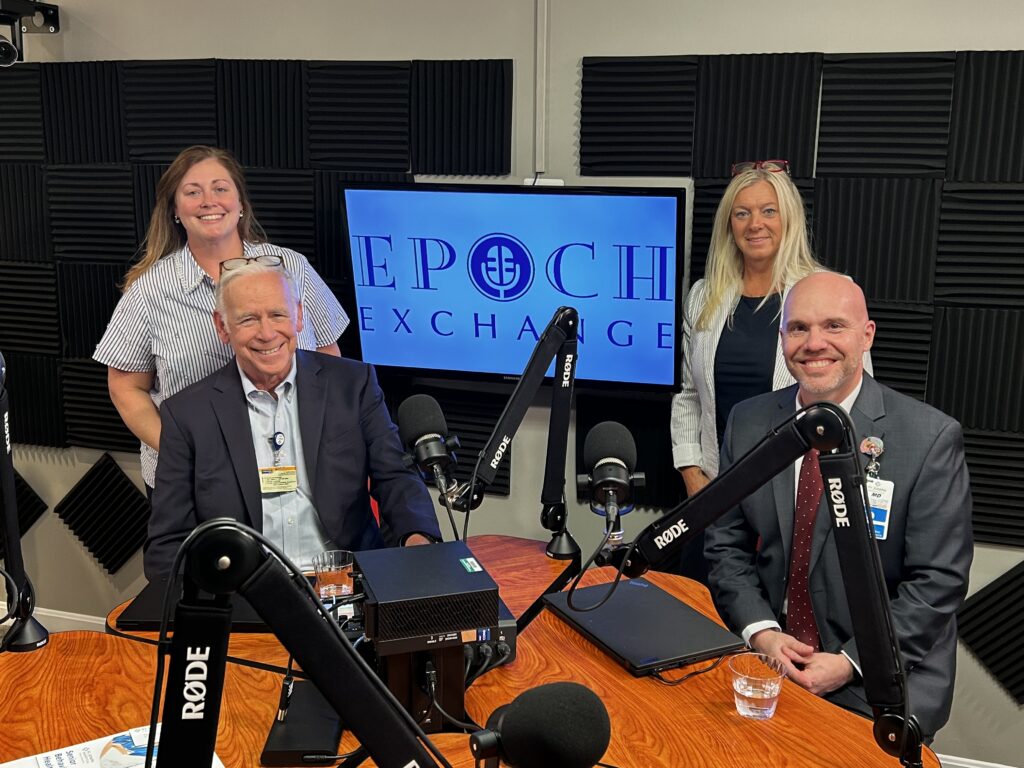
Guests:
Dr. Raymond Suarez
Director of Senior Behavioral Health Unit, St. Joseph Hospital, Nashua
Peter Burke
Community Education Manager, St. Joseph Hospital, Nashua
We discuss:
- Why dementia is an umbrella term, and how different types of dementia can affect memory, mood, behavior, communication, and daily functioning in different ways.
- Common forms of dementia, including Alzheimer’s disease, vascular dementia, frontotemporal dementia, and Lewy body dementia.
- Why an accurate diagnosis matters, especially because symptoms, progression, and treatment approaches can vary by dementia type.
- How behavioral and emotional symptoms may appear, and when specialized behavioral health support may be helpful.
- The importance of collaboration when dementia symptoms become more difficult to manage.
Episode Transcript
Hi, and welcome to The EPOCH Exchange, a podcast where we bring together experts and community voices to share insights and guidance about senior living, dementia care, and healthy aging.
I’m Sarah Turcotte, Area Community Liaison for our Bridges by EPOCH and Waterstone communities.
And I’m Wendy Sage-Matsis from our Bridges by EPOCH at Nashua community. Today, we are excited to welcome two guests who have become wonderful partners through our longstanding collaboration with St. Joseph Hospital’s Senior Behavioral Health Unit. Together, we’ve had the privilege of working alongside their team over the years and have seen first-hand the incredible impact they make for older adults, families, and healthcare professionals throughout our region.
And our first guest is Dr. Raymond Suarez, Medical Director of St. Joseph Hospital Senior Behavioral Health Unit. Dr. Suarez has led the unit since 2021, providing specialized inpatient behavioral health care for adults 65 and older who are experiencing significant behavioral and emotional symptoms. He earned his undergraduate degree from Cornell University, his medical degree from Albert Einstein College of Medicine, and completed his psychiatry residency at Montefiore Medical Center, where he served as chief resident.
He is also the creator of Cognitive Caring, an online resource dedicated to supporting older adults and their caregivers.
We’re also delighted to welcome Peter Burke, Community Education Manager for the Senior Behavioral Health Unit. Peter brings a unique background in healthcare marketing, communications, and community outreach, having spent years helping healthcare organizations connect with the communities they serve. Before joining St. Joseph Hospital, he led the marketing and community relations for the Farnum Center, and previously founded his own healthcare communications consulting firm, Linchpin Communications.
Today, Peter plays an integral role in building awareness of the Senior Behavioral Health Unit and fostering partnerships with hospitals, senior living communities, healthcare professionals, and families throughout New Hampshire and Massachusetts. And today’s conversation focuses on understanding the various forms of dementia and the important role behavioral health can play when symptoms become increasingly difficult to manage.
We’ll discuss how dementia types can present differently, when behavioral health services may be appropriate, and how collaboration between hospitals, senior living communities, and healthcare providers and families can lead to better outcomes for those who are living with dementia. Dr. Suarez and Peter, thank you so much for being here with us today. It’s truly a privilege.
Yeah Pleased to be here.
Yeah, no, truly a pleasure, especially having the pleasure of working with you all over the years and supporting family members and their loved ones. It’s really an honor to have you here to educate and share your knowledge and insight with our listeners.
So I guess, can we just start, just jumping into things here, can you just start by explaining, when we hear dementia, it’s really an umbrella term. So can you really just explain to the audience, what is dementia?
And it’s a great question, because it is an umbrella term. If you look in the DSM, there’s about 13 different subtypes of dementia. So it encompasses a lot of different symptoms, a lot of different illnesses, and recognizing it early is actually key.
So there’s a difference between the forgetfulness that may happen with normal aging and an actual cognitive decline due to dementia illness.
Sure, and can you just explain, why is it important to identify the specific type when possible?
Sure, and it’s a very good question as well. So the cognitive decline can present differently with the different subtypes of dementia. Specifically, there’s one called Lewy body dementia, which comes on relatively quickly, relatively early age, and severe when it usually comes on, presenting with things like psychosis first. The reason it’s important to recognize the differences is because the medications that we use to treat these illnesses can be detrimental to Lewy body dementia.
So you can give them a medication for the psychosis, which is their primary symptom, and it can actually make the symptoms worse. And so it’s important to recognize that because families can lose hope when you start a medication, and the symptoms can get worse, and then they may not want to get treatment anymore.
No, that raises a really good point, and we are familiar with Lewy body dementia within our organization at EPOCH, and most especially at Bridges. But can you just kind of share what are some of the other more common types of dementia that you’re seeing and family members might be working with?
So I might be aging myself, however, when I was in training, really Alzheimer’s dementia was the main type of dementia, and we learned about the other types, but we were taught you’re rarely going to see this type of dementia.
Now we’re seeing more and more. So the three, four main subtypes of dementia, Alzheimer’s is still number one. That’s the main subtype that we see, followed usually by vascular dementia, and then something called frontal temporal dementia, and Lewy body dementia. Those are the four big categories that we see. They can present very differently. Usually, Alzheimer’s is the one that people are more familiar with, where patients start getting a cognitive decline.
They start being forgetful, having difficulty finding their words, maybe getting more confused and lost in the community, and usually it progresses slowly with their decline. The vascular dementias are specific to where that vascular injury happens.
So if someone has a stroke, TIAs, some loss of oxygen to the brain, you can have injury to the brain tissue, and depending on where that is, you can have the cognitive decline, the behaviors that present with that. Frontotemporal dementia presents almost, you usually present with more mood symptoms that happen first.
So the cognition can still be there, but we’ll oftentimes get referrals where there’s a new onset of depression-like symptoms or a new onset of manic-like symptoms in someone who may never have had a psychiatric history. The cognitive decline happens later in the frontotemporal dementia, so you’ll see the behavioral changes first. That also presents usually earlier than Alzheimer’s type.
And Lewy body dementia is pretty much the opposite presentation of Alzheimer’s. So with Alzheimer’s, you get the forgetfulness first, and then towards the end of the illness, you can have psychotic symptoms. Lewy body presents usually with the psychotic symptoms first, specifically visual hallucinations, and then progresses to a cognitive decline.
I have a question for you, and then a follow-up for you, Peter. Is there ever a point in time in the disease progression where you would tell a patient or families, “At this point, it doesn’t matter to know what type of memory impairment or dementia you have, let’s just treat the person,” or is it best to always know?
So, as I said, with Lewy body dementia, it’s good to know up front so we can choose the right medications. Oftentimes, it is through a clinical trial that we figure out that it’s a Lewy body dementia. If you had asked me this question about 10 years ago, I probably would say, for the most part, it doesn’t matter in terms of the treatment, aside from Lewy body, because we treat the symptoms the same.
However, excitingly, there are new treatments for Alzheimer’s-type dementia that if you catch early, can actually reverse or prevent progression of the illness, which is an IV medication, and you can go as an outpatient and get the treatment. So in that case, early detection is key.
Great. And Peter, so I know we see you out and about all the time. I think nobody networks better than senior living professionals. But talking about the senior behavioral health unit and patients that come in and admissions, what are you seeing out there when you are visiting other communities or talking to the public? Is there a great need for the services that you are offering in your unit?
Yeah, I think there is a great need. Well, to begin with, behavioral issues are really commonplace among older people. I’ve seen some stats that put it at maybe 20 to 25% of people 65 and older who have some form of behavioral disturbance or condition.
So it’s commonplace. People are having that experience within their families. And for the most part, there just aren’t too many units like ours. So there’s the demand, there’s the need. Really, we’re based in Nashua, however, we’re very close to the Massachusetts border, so a lot of our patients come from Massachusetts, and certainly from New Hampshire.
And you can really count on one hand within New Hampshire the number of hospital facilities like ours, and there really aren’t enough in Massachusetts. And the situations that families find themselves in can be rather desperate, can be overwhelming, just dealing with the impact of what’s going on.
And so we find people that really are searching for help, and we like to feel we’re at least a good resource for them.
Oh, 110%. The other thing that you guys are hitting on is that unless you are going and caring for someone who’s living with dementia, it’s not just forgetfulness, it’s more than just memory loss. There are symptoms and behaviors that coincide with this illness. And can you just explain to the audience members what this looks like and why it’s happening?
So the memory, obviously, most people are aware of that part. But as the illness progresses, you can have behavioral changes. People can get agitated, aggressive. Sometimes it’s because of the confusion, sometimes it’s because of where in the brain that we’re having these plaques and lesions happen. You have a disruption in what’s called executive functioning.
So that’s the part of our brain that allows us to have complex tasks. So for example, knowing what time I needed to be here today, navigating here appropriately, even just getting up and sequencing those events in the morning, that’s our executive functioning.
And when that’s lost, that leads to a lot more behaviors that, for caregivers at home, that are problematic, not being able to attend to what we call the activities of daily living, so not being able to shower, dress themselves, appropriately cook meals, even being able to use the restroom.
So for caregivers, those tend to be the more difficult symptoms to deal with.
And are there common triggers or things that families, like you’re saying, that they’re experiencing, and that maybe they can recognize before maybe these behaviors escalate? What are things caregivers should be looking for?
So we’ll oftentimes get patients that come in and the caregivers will say, “Oh, mom, dad has been fine until now, and all of a sudden there’s been this rapid decline.” But when you look back in time, oftentimes that’s when families don’t live together, so they’re not seeing them on a day-to-day basis.
And when you look back, well, maybe they have been forgetting more important dates, birthdays, anniversaries, when this was someone who always paid attention to things like that. Bills that aren’t paid, mail that’s been piling up on the desk. Their refrigerator may have things that are expired, or they haven’t gone to the grocery store in some time. These are key things to look for. Maybe they’re wearing inappropriate clothes for the weather.
When people start seeing things that are concerning. And for any family, I would recommend, if you are concerned in any way, shape, or form, you can start with the primary care physician to have some screening done, tests done, because the dementias are a rule-out in the beginning. You need to make sure medically nothing else is going on. People are aging well longer, but part of that is because of medications that we have, and those medications sometimes don’t play nice together and can cause some confusion with the older clients.
Our metabolism changes as we age, so just how we process those medications can change. So I would start with a primary care, just screening. And having these conversations early also opens you up to getting help in the community before things go poorly. We see that a lot with our families.
And we were actually just talking, we’ll meet families, and maybe they’re just gathering information or doing some research, and their loved one is steadily going through their memory impairment process. And then inevitably, a point in time, not all the time, but we’ll get that phone call that, “Oh my gosh, we need to do something immediately.” Yeah.
And I think so many families, so many people are always wondering, “What happened?
Why did this happen?” We like to say, “If you’ve met one person with memory impairment, you’ve met one person with memory impairment.” But just knowing, and you guys are seeing it every day. You’ve got people coming in and discharging from your unit.
Are there other ways or other things that family members, caregivers, might be looking for that might be triggering or a sign that, hey, something significant is coming your way?
Or, is this beyond more than what I can manage at home?
Yeah, and I think, asking for help in the beginning, sometimes people feel like, well, they’re failing their loved one. They’re afraid of what might be coming down the pipeline, but getting that help early is always important, and I use the analogy in the hospital, usually we’re in the room bedside with the family members, and I’ll say, “Can I move this bed on my own?” Sure. “Would it be better for me to ask for help?” Yes. Doesn’t make me weak. It makes me actually just intelligent to do this the easier way rather than struggle through on my own. So asking for help, I think, early is key. And to touch on your point about the rapid progression of the cognitive decline, clinically what’s happening in most of the dementias is these plaques are getting put down in the brain.
And what I like to tell family members is imagine that all these neurons are like a highway. It’s a four-lane highway. Everything is running smoothly. Traffic is going smoothly. And then these plaques start getting put down.
So it’s like one exit gets shut off. There’s an accident at one exit. Cars will reroute, slow down a little bit, but traffic is still moving. Then they’re doing construction on another exit. Then a tree falls in another exit, and so on and so forth.
So the traffic is rerouting, rerouting, rerouting, slowing, slowing, slowing, until that last exit gets stopped, blocked, and then everything comes to a complete halt.
Yeah, it’s a really, really good analogy. I appreciate you sharing that. One- I think occasionally we’ll see one reason why maybe people have not sought help earlier is some of the family members are in denial about what’s going on.
It’s a tough situation, and it’s almost easier for some of them to say, “Oh, we must be imagining that,” and kind of put it out of their minds, and then things compound, and then they’ve got more to deal with.
And then there’s still, for all the talk about eliminating stigma, I think we’ve done a pretty good job chipping away at it, but there still is some stigma attached to admitting that the situation’s going on and seeking help.
So the more that people can get beyond that, it will help everybody involved.
Oh, 100%, because oftentimes we see once they do start tapping into these resources and the communities, we always hear, “Oh, I wish I would’ve found this sooner.” Yeah.
So you raise a really good point. And talking about education and stigma, you guys are supporting St. Joseph’s Senior Behavioral Health Unit. We also hear them called Gerry Psych Units. And I really would just love for the audience to understand what that truly is.
And it’s very different than a general inpatient psychiatric unit for general adults. We can serve the community for general psychiatric illnesses like bipolar, depression, anxiety, and so on and so forth. But the majority of the patients that we treat have a cognitive decline, and specifically, a cognitive decline with behavioral disturbances.
So, that means that when the patient’s behaviors are no longer able to be cared for in the community, or they need some type of medication adjustment, they can come onto the unit. It’s a relatively small unit, but it’s 65 and older, and that’s our area of expertise. We are able to treat the population from all angles.
So because we’re a geriatric psychiatric unit, we have physical therapy, occupational therapy, a nutritionist that sees every one of the patients there. We have social work, case managers, the nurses, myself. We have a medical doctor that comes and sees every single patient.
So, we attack from all angles to make sure that we get a treatment plan for that specific patient that can help that specific patient. We also work with the families. We do family meetings, educations. And people are able to call us anytime to find out more details. It’s a voluntary unit, so it’s not like the old views of “One Flew Over the Cuckoo’s Nest,” where you just get locked in and you’re there forever. We’re a short-term unit, seven to 10 days on average. Some people are longer, some people are shorter. Depends on the medications and the type of illness that they have.
But families are welcome to come. And we work with sites such as yourself to work on discharge planning if they cannot return to their previous living arrangement, and we can help with things like that as well.
And we have appreciated the incredible partnership. I know, Peter, we probably see you at least once a month, and we’re in, we’re meeting with all of those people you just talked about to make sure.
And it’s not just us, it’s other members of the greater Nashua area healthcare community that you guys are working with. So, we all appreciate that, knowing that this is in our backyard. Is it five or six years now that you have been there?
About five and a half. We opened right at the end of 2020.
Oh, yeah. That’s a great time. Right smack in the middle of the pandemic.
Very good time to open. And so it was a challenging time, but I give kudos to the hospital. Originally, that was a med surg floor. Then, I guess they had a plan of making it maybe a COVID overflow floor.
But when that need didn’t really materialize, they did a pretty quick pivot, knowing the aging population, the need for more beds like ours. So kudos, I guess, to John Jurzyk, the president of St. Joseph, and the board for taking the steps necessary to build the unit.
And you’ve seen it, so it is what it is, but it’s certainly pleasant, bright, airy space. And the beauty of it being as relatively new as it is, that when it was constructed, an awful lot of thought was put into safety features, safety devices, really keeping the patients safe, and if there were any thoughts on the part of any of them of self-harm, mitigating those possibilities.
Great. So it’s great that way. I arrived just before we opened, so I’m sort of the historian of the group. It’s good to have. So. It’s like Sarah with- this podcast and stuff. And I know we have many more questions we want to ask, but I was looping this in because I know you have a favorite story from when you first met Dr. Suarez and had gone to see Peter at the behavioral health unit. I don’t know if you want to share that.
Yeah, no. Well, like you said, you guys really are coming at it at a multi-approach when it comes to supporting the patients. And I’ll tell you, I have always remembered this story because the first time I ever was visiting and taking a tour of the behavioral health unit, I was walking off the elevator, and you were walking on, and you said, “I’m so sorry to miss you. I was looking forward to it, but I have to run out because I have a patient who will only take their medicine with ice cream, and we’re all out of ice cream.” Because again, it was COVID times.
And I just said, “Wow.” To see a medical provider who is going out of their way to make sure their patient can benefit from the care approach, because truly, it’s focusing on quality of life.
Absolutely. And what you guys are doing in the care and treatment that you’re providing, you are achieving that for people who are coming to you in a really difficult situation.
And I really would love for you to just share with caregivers, because you mentioned the guilt, right? The guilt that comes with this. What would you say to a family member caregiver who’s feeling guilty about seeking this type of support? What would you share with them?
So when I speak with them, and everyone does, right? You have your loved one, and you’re putting them in a hospital, and it feels like you’re locking them away, or you’re going to a nursing facility, and it feels like you’ve failed them in the community. However, they’re providing the care that their loved one needs at that time.
And it would be more dangerous at that time to be in the community, or wherever they were prior to coming in. And so they’re letting them actually live their best life at that time. They’re giving them more resources. They’re allowing more freedom. Even though it seems like you’re taking it away, you’re not. You’re allowing more freedom safely for their loved one.
Let’s pivot a little. Is there a way for someone, or a caregiver, or a family member to tell the difference between this is just some normal aging forgetfulness and this is dementia or memory impairment, I need to seek a medical evaluation.
Sure, and that’s a great question. Because as we age, we all start not functioning at our best. Our reflexes slow, our memory is not the best. The difference being that executive functioning part.
So for example, again, using myself as an example, in order to remember that I had to come here today, I wrote it on the calendar and had a reminder that told me. So I wasn’t just relying on my memory, but I use an executive functioning to say, “All right.
How do I problem solve for the fact that I’m busy, I might forget?” Things that are common that are not a Alzheimer’s type dementia or any type of dementia would be you forget where you put your keys. You forget little things. You forget why I walked in this room today.
But you can figure it out and problem solve around that, being able to prevent it from happening again. Once you see more forgetfulness of important names that you should know this person’s name. We’re not talking about an acquaintance that you had or someone you met a while ago. We’re talking about close family members, close friends, and you’re forgetting their names. They’re having a difficult time with problem-solving of things, maybe doing things incorrectly. They may start confabulating answers.
So they’ll forget, but they’ll cover up their tracks. They may not be answering in-depth questions. And that’s how actually a lot of this is missed because unless you’re really pushing someone for answers, we all just have superficial interactions. “How are you doing today?” “Okay.” But you never asked what the date was. Do you know where you are right now?
And these are sometimes how it’s missed. But if you’re with someone long enough and you notice these things that just don’t seem right, it doesn’t seem like a normal type of aging. And I know you asked the question of how do it’s not normal, but you know. There’s a difference between just being a little forgetful and there’s a problem. By definition, the medical definition, is that it’s causing a problem in your life.
So if they’re having difficulties going to their doctor’s appointment, forgetting how to get home, things like that are red flags that you should get checked out.
Yeah, really, really great advice. And just kind of on a parting note, final kind of advice that you would give to family members and would just also love for you to share a little bit more on how to find your cognitive caring resources. I would love for you to just share some final thoughts with our audience members.
So, I think the biggest thing is if you see something, say something mentality. If you’re concerned, get it checked out. There’s no harm in getting it checked out. As a matter of fact, it’s helpful because even if there is nothing wrong, you have a baseline.
So we know where this patient is at this time. The things that people forget oftentimes is the caregiver themselves and caring for the caregiver because it is a very stressful thing.
Financial planning is part of it because people are not educated to know what is this going to look like and how am I going to move forward with caring for this person?
And just looking for the help when they need it. There is no shame in the illness. There’s no shame in asking for help, and it’s actually, in my opinion, the earlier you do it, the better it is. As I said, now with the new medicines, if you catch it early, you may even be able to stop it.
So that’s an important thing. And I have a lot of resources. I made a website called cognitivecaring.com, free resource. There are two tabs there that are very important for caregivers and patients. There’s an education tab, which goes through all the different types of dementias and other illnesses that can look like dementias, medical illnesses, other types of psychiatric illnesses, and how they look in geriatric patients.
And there’s a resources section, and that has a bunch of links both local and national to different cognitive websites, to legal things that people may need. There’s a whole bunch of different websites there just so that people can be educated and start having these conversations early.
And Peter, if somebody wanted more information about the behavioral health unit, what’s the best way for them to find that?
Well, they can certainly reach out to me at St. Joseph’s, call, email, whatever it might be. We do have an intake coordinator on our team, and she fields the initial inquiries that come into the unit to kind of sort through some of the clinical information and then review it with Dr. Suarez to see whether the person might be appropriate for the unit or not, or whether the unit’s appropriate for the person.
So we have a pretty smooth-operating intake process, which is helpful. But people can always reach out to me, and I’ll get them the answers. Great.
And we’ve been so fortunate to work with you on both sides of that, helping somebody with an intake process, and then on the flip side, when they’re ready to leave your unit, whether they are coming from us and returning to us, or they need a safe place to land once they’re discharged from there, you have amazing social workers and case managers that are constantly in contact with other communities like Bridges and providers that you’re doing such a great job making sure that people are safe.
And they work very closely with the patients and their families almost from the moment they walk in our door to ensure that that happens. It truly takes a village, and I’m grateful to be a part of your village, and grateful, again, for you guys to be here to share your knowledge and your expertise with our listeners.
And honestly, I feel like we could have you come back again for a whole another topic. But until the next time, we hope you take care, and we hope you’ll join us again on The EPOCH Exchange. Thank you for having us. Thank you. Thank you.
Want to Learn More?
Visit our guides to dementia and Alzheimer’s and memory care. These articles are a great place to start learning about this disease and what care looks like in a memory care community.
Dr. Suarez has also created a fantastic resource for dementia education: Cognitive Caring
For more answers to quick common questions, visit our FAQ page.
You can also check out our upcoming events for caregiver education and support.