
Listen/watch our EPOCH Exchange podcast episode below.
Released November 2026 | Duration: 28:05
In this episode of the EPOCH Exchange, Sarah Turcotte and Wendy Sage-Matsis welcome Angela “AJ” McDonald, Practice Administrator and Care Navigator at the Boston Center for Memory, to discuss how a dementia diagnosis can affect children and teenagers. AJ shares practical advice for helping younger family members understand the diagnosis, adjust to changes in someone they love, and cope with the challenges that dementia can bring to family life.
We discuss:
- How to explain an Alzheimer’s or dementia diagnosis to children and teenagers using honest, age-appropriate language.
- Helping younger family members understand changes in memory, personality, and behavior without taking hurtful words or actions personally.
- Signs that children may be struggling emotionally, and how parents can encourage them to express their feelings.
- Ways to adapt familiar activities and family traditions, while ensuring children and teenagers aren’t expected to take on too much caregiving responsibility.
- How families can prepare for changes in care needs and manage the demands of caring for both younger and older generations.
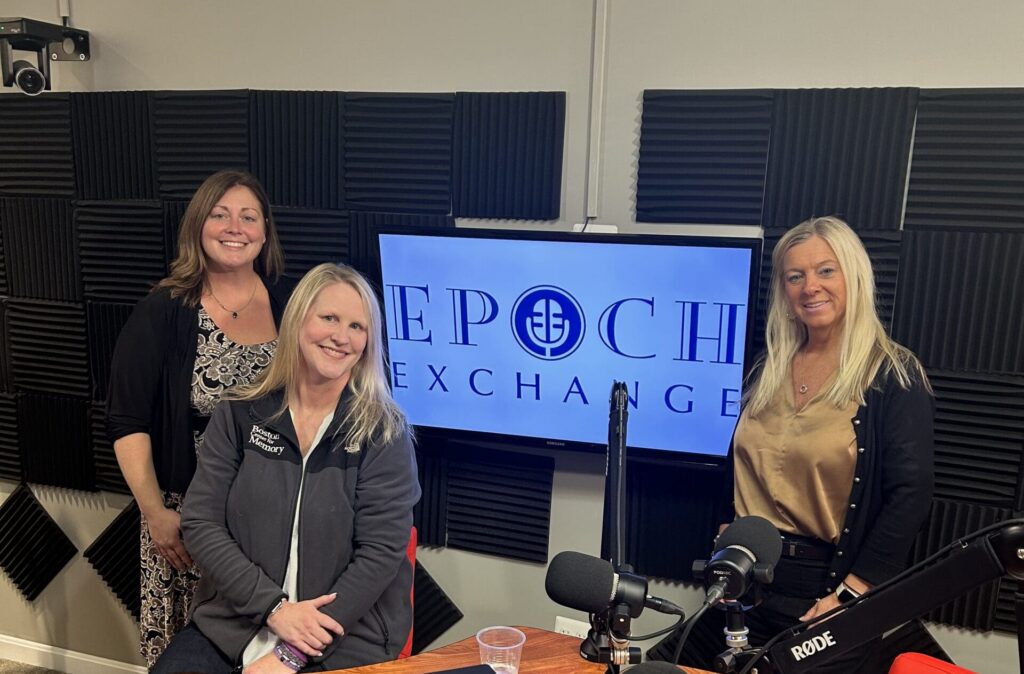
Guest:
Angela ‘AJ’ McDonald
Practice Administrator and Care Navigator at the Boston Center for Memory
Episode Transcript
Hi, welcome to the EPOCH Exchange, a podcast where we bring together experts and community voices to share insight and guidance about senior living and dementia care. I’m Sarah Turcotte, Area Community Liaison for our Bridges by EPOCH and Waterstone communities.
And I’m Wendy Sage-Matsis, Senior Advisor at Bridges by EPOCH in Nashua.
Today, we are excited to welcome Angela “AJ” McDonald, Practice Administrator and Care Navigator at the Boston Center for Memory. AJ brings more than 20 years of experience in senior care and dementia care. She’s also the founder of The Red Balloon Dementia and Alzheimer’s Consulting Services, and serves as an Alzheimer’s Ambassador for Massachusetts.
She’s passionate, which we were just talking about, helping individuals and families navigate dementia through education, advocacy, and support, and we are so happy to have you joining us.
Yes, we are, and she is very good at all of those things. And today, we’re here to talk about a topic that I think deserves more attention, how a dementia diagnosis impacts the younger members of a family. When someone receives a diagnosis, we naturally focus on the individual and their caregivers. But what about the children and the teenagers and the younger folks in the families who are also witnessing these changes?
How do we explain dementia in a way they can understand? How do we prepare them for changes that they see in someone they love?
And how can we help them maintain those special relationships? We’re going to explore these questions and share some practical guidance for families navigating dementia across generations.
AJ, thank you so much for being here today. Thank you for having me. Yeah. So, I think one of the biggest challenges for families is really just simply knowing where to begin. Someone receiving a diagnosis at any age can be devastating, but most especially for someone who’s dealing with this at a younger age. Even adults can struggle to understand dementia, so trying to explain it to a child can feel especially overwhelming.
So AJ, before we jump in and dive into some of the questions we have for you today, I would love to just start off by sharing with our audience members, how did you become passionate about dementia care?
You have been doing this for a long time, so I would love for the audience to hear a little bit about your journey and how you fell into this passion. Yes, thank you so much for having me.
So I started out as actually a physical therapist, and one of my first jobs was working at a local nursing home here outside the Boston Metro area.
And I just had a real knack of working with the patients on the Alzheimer’s units. And so I went back to school, got a degree for neurology, really loved neuroscience, and created that passion into a purpose, and started working as, and worked my way up kind of as a memory care director, then executive director of an all memory care assisted living, and now here I’ve landed at Boston Center for Memory at my dream job.
That’s amazing. And you are helping families of all stages and ages at Boston Center for Memory. Can you share a little bit about Boston Center for Memory before we dive in?
Sure. Boston Center for Memory, it’s located in Newton, Massachusetts. It is a clinical and a research diagnostic center. So we have clinical research trials that look at MCI and Alzheimer’s disease, but then we also have our diagnosis side, the clinical side, where we’ll provide neuropsych evaluations, provide patients and their families with a diagnosis, treatment, and support.
And I’m guessing through all of those processes with the patients you’re treating and families, you are kind of a point of contact for them. Yes. A lot of this can be deer-in-the-headlights. We’ve just received this diagnosis, what do we do now, and how do we talk to people about this?
Yes, absolutely. So the way we start it, I do pretty much every intake that comes through, kind of deciding if that patient is an appropriate candidate for our side, or if they would be better served at maybe one of the larger hospitals. We don’t have a cookie-cutter approach to this disease. We very much want to treat every individual and tailor the style. Following that, and they go through their process of the neuropsych evaluation, and the neuro exam, MRI, and then the diagnosis. Then they have a follow-up with me as the care navigator because it is, it’s so overwhelming.
And that way we can give them kind of a light at the end of the tunnel saying, “Hey, listen, you’re not alone. You’re not on an island. Here are the supports.” Mm-hmm. And then we provide them with the necessary resources, whatever that may be. And it’s different for everybody. It really is. And we’ve been in the industry for a long time, and we work with a lot of seniors and family member caregivers, but we are, most especially over the last several years, seeing folks come to us younger and younger, and I’m sure you’re seeing the same, and it’s a little bit different, wouldn’t you say?
Absolutely. So it used to be where I was giving caregiver support for the grandchildren, and now it is a child, because the patient coming in is in their 40s, and it’s their teenage child or their younger child that I’m providing support to, which wasn’t typically our mainstay.
Right. I have a, so in the years of doing this, probably one of the calls that will haunt me, I took a phone call from a woman who was a few years older than me, and this was five or six years ago, and she needed a place to turn. They had a 12 and a 14-year-old living at home, and her husband was early diagnosis, and just through the changes with the memory impairment, things were getting harder and harder at home. And her son came to them and said, “I know you need to take care of Dad, but can I live somewhere else?”
Because it was getting harder and harder. And I’m sure you’re meeting families like that. Right. What would you say?
There’s different things we’ll say for different people, but in that particular situation, you need to know what’s best for the child at that point in time, too. You don’t really want to break up a family because of everything. But the caregiving burden is just so enormous. Let’s say it’s the husband in that situation that has the Alzheimer’s diagnosis, well, the wife is going to have to coordinate his care. She’s still going to have to be going to work. There’s just a number of factors going on.
So finding her village is what I call it, is making sure that her children are provided for, and that may mean living with a grandparent during that time. Sure. And I just think, even from the start, families get this diagnosis, or they’re noticing these changes at home.
How should families be approaching their younger children and explaining this to them?
Yeah. So I think it’s important just to, you do need to have a sit-down and have an initial conversation to unpack everything that’s going on. I think that using very simple language that is age-appropriate, it’s going to be different for younger children than it is going to be for teenagers. But being honest about what is going on, but not being scary about it at the same time. And that’s kind of a hard balance to strike. Mm-hmm. So is this more like an ongoing conversation, or are we doing everything at once?
Give some advice to someone who’s going to approach something like this. Yeah. So I think definitely you have a sit-down kind of conversation, private, it’s quiet, and have that initial conversation that maybe something’s going on with Dad, or maybe something’s going on with Grandma. And really gauge where they are at first, because you don’t want to overwhelm them with scary details that maybe they weren’t privy to yet. And just ask them kind of where they’re at with it.
What have you been observing? And then explain that it’s a disease. Grandma is sick. Her brain is sick. And then provide a diagnosis. “Hey, she’s sick, but it has a name.” Because we do need to identify what this is. So you think labeling it as Alzheimer’s, as dementia, and really providing the education around it is helpful.
Absolutely. Okay. So now I guess we have, we’re explaining the diagnosis and providing the education, but we all know that this illness comes with symptoms. And I think that the symptoms is the hardest piece for some of these families. So when children or younger folks are exhibiting some of these symptoms, how can families best explain some of the odd things they might be seeing?
Yeah. I think, too, again, going back to that peeling the onion and making sure that the child is observing these things. What are they feeling about it?
Validating those feelings. But then saying, “Grandma might be curt with you. She might be short with you. She might be yelling at you, but she’s not mad at you.” And separating Grandma from the disease itself. Making sure that the child knows that this is not contagious, that they’re not going to be getting this. There’s a lot of fear that is surrounding this diagnosis, not even for children, honestly, for adults as well. True. So making sure that we’re explaining those different things and all of the different symptoms.
This is not a disease of just memory loss, so understanding all of the different things that come with it. It could be the emotional outburst that Grandma has. But understanding that this is coming from a different place. Or the repetitive thinking, like, “Grandma said that to me like 10 times already.” And sitting in that moment and having the conversation, not putting it off till later, having those honest kind of conversations are really important.
Are there, speaking to that type of stuff, are there books or movies or things you might recommend that could help reinforce what you’re talking about or the message you’re trying to get across to children within that realm of what we’re talking about right now?
Yes, absolutely. So the Alzheimer’s Association at www.alz.org has a great reading list for children. Two of the ones that I frequently recommend are “The Remember Balloons,” and then “Nana Nana” by Nate Bertone. He’s a phenomenal individual, but he’s actually local to this area, and he worked on Broadway on sets and things like that. And he put together a children’s book that is just absolutely incredible in explaining that. There’s another great one by Ann Frantti. Hard to come by now, I think it went out of print, but it’s called “Grandma’s Cobwebs.”
So if you can find that, even at a yard sale or something- Okay. Do look out .. I will highly recommend that one. Those are great. Those are really great. And I really love those suggestions because I think everyone sees it through a different lens, right?
Absolutely. So I think having various books and different tools to look into is helpful. And as you were saying earlier, it’s not just hard for younger children, but adults too. As people change with dementia, they might say things that seem hurtful or out of character.
And I really want to not only talk about how do we do this for children, but ourselves. How do we not take things to heart?
How can we best explain this to families? So I know this sounds strange, but I do say to a lot of people that you do have to dissociate in a sense. You have to take the disease and the person individually. And it’s hard to see that those two things are interwoven.
And I see it with my family members all of the time. And so you want to really separate that out, because the brain is what is sick, not the heart, and the person still loves you, they still care about you. But the disease is making them do things that is not the normal person. And that can be said for a lot of different diseases, but specifically to Alzheimer’s, you see a lot of these personality changes and things of that nature that can be very hurtful to the people, because they still look the same.
That’s still grandma, and she still makes her cookies, and this, that, and the other, but she screamed at me, and she normally wouldn’t do that. And then just going through that, explaining that. I like to use a lot of analogies as well, too. Simple analogies for people, in children and adults. Your brain is like a roadmap, and you’re going through on a road trip, and you get to a certain point, and there’s a boulder in the middle of the road.
Well, we’re going to have to go around, and the trip’s going to take longer, but we’re going to still get to our destination. That’s what happens to a person’s brain with Alzheimer’s, is that they are trying to get to their destination. They’re trying to do the task they always did, and that neural circuit, it’s not connecting, so they have to go a different way. So it takes them longer to get there, and that’s very frustrating. If any of you have broken your hand or broken your foot and you have to go do something, it’s very frustrating because you want to get to the bathroom, or you want to get to here, but you can’t do it.
And you can see that injury. You cannot see a sick brain. That’s true. And along those same lines, what advice might you give for the child or the family members that have traditions with their loved one, and all of a sudden, things are looking different?
How can you still do some of those favorite things or favorite traditions, especially coming up into the holidays, with a loved one who has memory impairment, that it might be taking more time, or everything just has to be modified?
I agree. That’s a great question, and I’m glad you brought it up. I think that it’s important to realize why are we doing what we’re doing for the holidays?
Are we doing it for grandma just to preserve the traditions, or are we doing it for ourselves?
Because yes, it definitely needs to be modified, but I think that it’s important to preserve those things, too. Because as we all know, the smell of baking banana bread and things like that can bring back memories that can.. We can help and do reminiscing activities. But it’s really about keeping it simple. Really keep it simple. You do not want to overwhelm. If you’re overwhelming grandma and grandpa, guess what?
Everybody else gets overwhelmed as well. So you may have to just simplify some things and just say, “We’re just going to be doing cooking activity together,” or, “We’re just going to sit by the fire and look at pictures,” or things that are more simple. Yeah.
And I think it’s hard for people at all ages, right? They’re going through the emotions of supporting their loved one, and I think adults go through frustration, guilt, anger, all of the emotions, but it can come up different for kids. They might not always be voicing their frustrations. And can you share what family members might see?
Because we were saying earlier, we are caring for this person. We might have to stay living with this person or involved every day. What are some signs that children might be struggling even if they’re not voicing this?
Yeah, I think that’s important to mention, is the fact that children are quite resilient, but they’re also quite observant. So they’re going to be picking up on a lot of the tensions that you might be feeling with your loved one with Alzheimer’s or dementia already. And they may have different presentations. So it might be withdrawal, it may be acting out, it may be trying to get their own attention because all your attention now is on your loved one with Alzheimer’s. So they may start doing things that are atypical.
There might be other things, physical symptoms. They start having stomach aches. They don’t want to go to school. They’re getting into fights at school. Their grades are dropping. Other different things that are not coming to you and saying, “Hi, I’m upset about grandma.” They’re not going to be that direct with you. As the adult in the room, you have to be the one to pick up on those things and address those things. And just like every patient has a different presentation with Alzheimer’s, every care partner has a different presentation of caregiving.
So we have to honor that as well. And you talked about using the right words, Alzheimer’s, dementia, memory impairment. Are there certain tasks you think different age groups could take on with this caregiving journey as a family?
Yes, I think that’s important, but I also think it’s more important, what I see on the other end of that, is that the teenagers typically try to do too much caregiving, and that is a weight that should not be thrown upon them. We need to still be protecting them because while they may think they’re grown up, we also need to protect the fact that they are still growing and impressionable, and that’s not fair to them. The whole situation’s not fair. But understanding, like, “Hey, we can still make cards for grandma.
We can still help bring over a meal and pick out something. We can still do certain activities together.” But I think making sure that we’re not putting a caregiving burden on the child or the teenager. Mm-hmm. And I guess just some advice for parents.
How can they create a safe or comfortable space and environment for their young ones to feel comfortable to bring these frustrations?
Are there things that they could do or offer that might help their younger person be more open?
I think it just starts initially with just the relationship you have with your child. Always making them feel that they can always come to you, always making them know whatever their feelings are, even if they’re angry, even if they’re sad, that those emotions are normal and human and okay to have.
I think there’s so much guilt with this disease, and I think that inadvertently, we as adults put our emotions on our children because we get frustrated with certain things, and I think it’s important to say, “It’s okay to still be a kid. It’s still okay to have a safe place, and if they don’t want to go visit grandma because it’s scary, that’s okay too. We’re just going to make grandma a card, and we’re going to mail it to her so we can still be connected to her.”
Well, and that’s just it, right? Yeah. Meaningful connection. Yeah. I know we talk a lot about the doom and the gloom and the, “Oh, how do we manage this, and what’s going to be next?”
But that’s the thing, is that every person can still have those meaningful connections and make it okay. And we talked about the safe space and doing different programs and different activities. What else can families help bring to the table to help children work through this diagnosis, through the changes that they might be seeing- Mm-hmm .. so that everybody is still okay. And having, I guess, a better and more positive- Yeah .. experience.
Right. It’s all about, and one of my favorite activity books for working with those with Alzheimer’s and related dementias is called Creating Moments of Joy. And I think that’s the thing, what it ultimately comes down to, is that it’s not about that journey, it’s not about the activity that you’re actually doing, it’s did grandma smile?
Did they connect? Were they holding hands? What kind of feelings did that evoke while we were together?
And sometimes silent togetherness can be some of the most meaningful type of togetherness. We don’t always have to be doing something all of the time. Right. Sitting in a room, listening to music, classical music, or things like that, that can bring about some sort of calmness and normalcy, and I think it’s normalizing it and not making it some big scary monster. Yeah.
And I definitely hear that organic, that kind of still time, but are there things, especially if someone has rather younger children- Mm-hmm .. what are some things parents can do for maybe a planned visit or time, or are there things that they can do to help create a better visit for their children?
I think it’s setting up the expectation with the child, too. Like, “Grandma might be forgetful. Don’t correct her. Don’t do things like..” And making sure you have those open conversations. But then the activities that you do together, things like beading jewelry, you can play some card games, things that go back to your muscle memory, things that are tactile, sensory. Because honestly, with a lot of being with younger children in their development, those two things go hand-in-hand. They go right well, no pun intended on that.
But I think it’s really important to make sure it’s something that they both enjoy, and that they both have input on. Because Grandma, Grandpa may just want to go for a walk, something that simple. Right. So obviously, you have been in this industry for 20 plus years. You’ve been on our side of the table- Mm-hmm .. and now doing what you’re doing. You are 100% fully supporting families.
What about that sandwich generation, too? Because I think that that caregiver oftentimes gets lost in this as well, where they’re caring for an elderly parent or a grandparent or somebody, and then the children that we’re talking about. How can that sandwich generation caregiver stay intact with both sides of the caregiving they’re providing?
I think it’s important, for me especially, looking at this, is the fact that being a care partner, you cannot pour from the empty cup. So first and foremost, I know everybody says, “You need to take care of yourself,” but I cannot stress that enough.
I think too many times we think about all the tasks. I’ve got the kids to school, I’ve got to pack the lunches, I’ve got to do this, I’ve got to go on the field trip, then I’ve got to go see Mom, I have to do all these things, and you have a task list, and that becomes your life. And then I even say, if you even can spend five minutes in the bathroom and scream into the mirror, or read a meditation, or whatever it is, you need to do that.
Because we cannot run on fumes, and we are human, and the most important advice I always give is just give yourself some grace. Because the sandwich generation, I am seeing it so many times as many intakes as I do, is most of the people have little children, and then they’re trying to run around, and then they have full-time jobs. And then it’s just like, “Oh, wait, when am I going to go get my nails done?”
And those things go by the wayside, but if they need that time, find your village, have somebody take care of the kids, somebody else can take care of Grandma for a little bit, and go get your manicure. Go get it done. Yeah. You’ve got to fill your cup. Yes. Good.
I have another question. I think this is a great question for family member caregivers as well as children, because we hear it all so often, is why might make this next step or decision when my loved one no longer remembers my name or who I am?
Which is a very sad part of the illness- Mm .. is feeling like your loved one does not remember you. How do parents explain this to their children if they feel like their grandparent doesn’t recognize them or know who they are?
Yeah, that’s one of the more difficult moments, and especially for the person who is sandwiched in that particular situation, too, because they typically forget that person as well. Again, it is separating it out. It is saying that, “Grandma still loves you. Her heart did not get this disease. She is still there. She’s still in there.” But I think having that conversation, that “She may not recognize you when we go in there, and that’s okay, still give her a hug.” And still make those connections. But I think that probably is probably one of the hardest parts of this disease.
And what are ways people can connect when maybe verbal or recognition is not there?
What are some ways people might be able to better connect in situations like that?
Is it photos? Is it music? What are some suggestions? I’m big on photos, for sure. I take a lot of them. And people make fun of me because I’m not on the Instagram person. I actually will print your photos out, put them in an album, because one day you’re going to want to flip through these. But I also think pets, music, are strong connectors. And it’s odd, but the multigenerational approach, where you have a child and an elderly person in a room together, there is some sort of emotional connection that is there.
I see an arc of some invisible thread that brings out this joy or the twinkle, that I say, in somebody’s eyes when they can’t name that person. My own grandmother, she couldn’t name me, but she goes, “I don’t know you, but I know I love you.”
And I see that all of the time. So I still think showing up, being present, you hear these stories all the time like, “Well, I’m not going to go visit. She doesn’t know me.” But you know her. Yeah. Yes. And it might not be the words. It could be the light up of the eyes, or the reach for the hug. Yeah. And even when the words aren’t there, it’s that emotion and connection that you feel, right?
Yeah. Actions speak louder than words. They do. Love is a verb. But on that same thread of how do you talk to the children when you know that they’re starting to forget your name, or maybe forget who you are, not everybody starts out on this journey living in some type of senior living community, for the most part. Correct.
How do you talk to a child about Grandma’s, Grandpa, Dad, loved one, is going to be moving, and this is why?
Again, I feel that it’s always going to be about an honesty conversation. “Grandma needs more help to take care of herself. Just like you have to live with me, when you were little, because you couldn’t take care of yourself, Grandma needs somebody to help her out now, too, because her brain is sick, and she’s not able to do the things that she used to be able to do.”
Sure. Yeah. You know what? We do have a couple minutes left, and I guess I would just love for you to share with the audience, is there a time where people should be maybe looking into additional resources or support if they feel like this is just too heavy on them or their younger family members?
Even if it’s not too heavy, I always encourage people to build their village. People were not meant to do this by themselves. This is not something you’re supposed to do alone. You shouldn’t do this alone. And I think that when you start seeing things already falling apart, you should have already done it. Hindsight is 20/20. So having that proactive approach to saying, “I’m going to go ahead and get professional therapy here. I’m going to go ahead and get the supports in place here,” having a plan.
And while that plan may not always be followed, you at least have some sort of foundation to support you through each next step. Because when you wait till the crisis happens, it’s usually too late, and you make rushed judgments that then you’re not happy with. There’s not one person that grows up and says, “I can’t wait to move to assisted living.” But at the same time, thank God these places exist so that people can manage these diseases and the things that happen, because when people start getting sick themselves, care partners often get comorbidities, a lot of illnesses themselves, and I think it’s important that we get that support in place ahead of time.
Because we’re almost out of time- Mm .. and I know we talk about a lot of stuff, is there something we didn’t ask you that you really would like to drive home for our audience?
I think it’s just really important to know that there’s help out there. I think so many of my caregivers come to me, and the exhalation that they have, like, “Oh my God, thank you so much. I had no idea all these things were out there.” A lot of times, people, we tell them, “Reach out if you need anything. Reach out if you need anything.”
Well, people, all of us, are responsible, and we need to reach in. If I hear that somebody’s loved one has Alzheimer’s or has dementia, I’m calling them. I’m giving, “What do you need?
I’m going to stop by, I’m going to bring dinner. I’m going to stop by and take care of the kids for a minute, let you have 30 minutes to go for a walk.” But I think it’s really important that they don’t know what’s out there. You don’t know what you don’t know. So if they’re going through a difficult time, know that they’re not alone, and offer your help.
But on the other end of it, when you’re faced with this, start researching and ask for help, too. It’s on both ends, but it takes a village, and you’ve just got to find yours. It’s important for the villagers to know, too- Mm-hmm .. that if someone in their village is experiencing this, to reach out and to extend outreach. Because sometimes people don’t ask for help. It’s one thing most people are guilty of doing.
Right. But I love what you said. Yes, we should be reaching out- Yeah .. but you also have to reach in. Right. Yeah. Because so many people, when they’re in the thick of this, they don’t know what they need. They’re just- They just need something. Yes. Yeah. And it’s exhausting.
And I think that’s the thing, is that, we’re all going to, at some point in time, need a care partner or be a care partner. So being on both ends of this right now myself, I think it’s really important that I continue to put together my village, and it’s coming together quite well. But I think it’s really important that we’re always cognizant of whatever other people are going through.
We cannot thank you enough, AJ, for being here, for sharing your expertise and your knowledge. It’s really great advice and feedback for our caregivers and family members out there. So thank you for being here. Thanks so much.
And thank you everyone for tuning into “The EPOCH Exchange.” Until the next time. Thank you.
Want to Learn More?
Visit our guides to dementia and Alzheimer’s and memory care. These articles are a great place to start learning about this disease and what care looks like in a memory care community.
For more answers to quick common questions, visit our FAQ page.
You can also check out our upcoming events for caregiver education and support.