
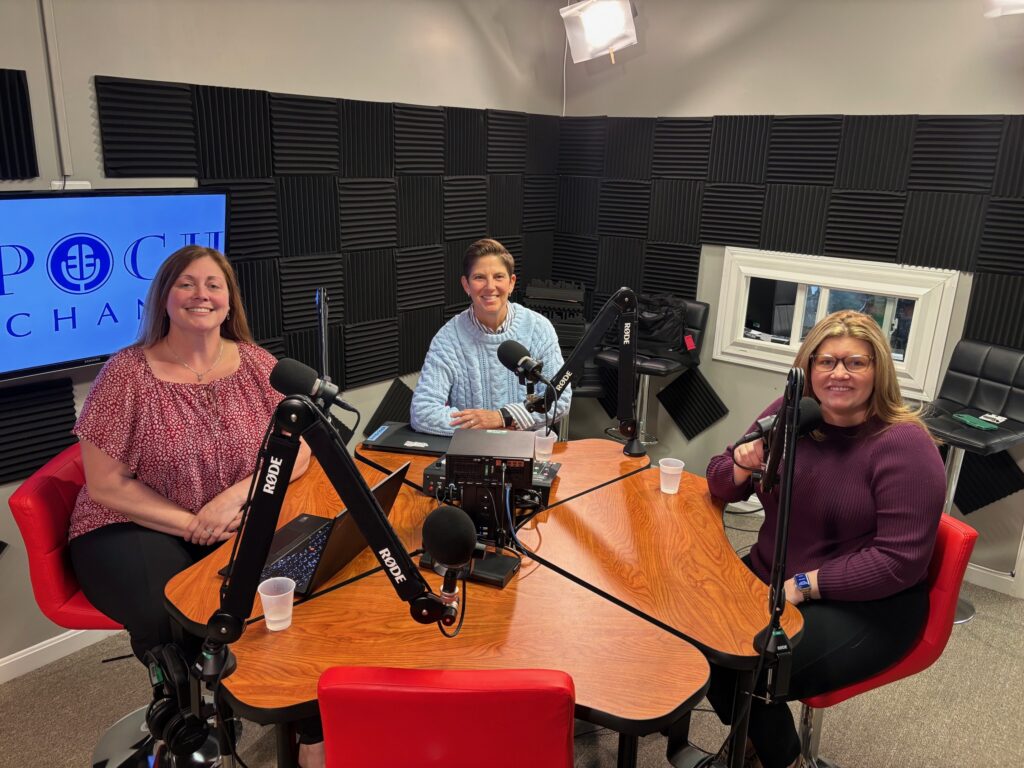
Listen/watch our EPOCH Exchange podcast episode below.
Released April 2026 | Duration: 26:32
In this episode, Sarah and Erica are joined by Kristin Johnson, an experienced memory care specialist, former Life Enrichment Director, and current Senior Advisor at Bridges by EPOCH at Sudbury. Together, they discuss the ethics of fibbing – telling small, compassionate ‘lies’ as you attempt to enter your loved one with dementia’s reality. This is a topic that many caregivers find difficult to navigate.
We discuss:
- What “therapeutic fibbing” means in dementia care, and why it can be a compassionate communication tool.
- Why correcting or reorienting a loved one can sometimes increase distress rather than provide clarity.
- Practical examples for navigating common situations, including asking to go home, looking for children, bathing, moving into memory care, or asking about a deceased loved one.
- How validation, redirection, and “stepping into their reality” can help caregivers communicate with more empathy.
- When therapeutic fibbing may not be appropriate, especially when trust, diagnosis, or stage of dementia are factors.
Guest: Kristin Johnson
Senior Advisor, Bridges by EPOCH at Sudbury
Kristin Johnson brings almost 20 years of experience in senior living with a specialized focus on memory care, life enrichment, and dementia education.
Episode Transcript
Welcome to the EPOCH Exchange, where we get real about senior living, dementia care, and everything happening in senior life today. I’m Erica Labb, Director of Team Member Engagement and Culture for EPOCH Senior Living. And I’m Sarah Turcotte, Area Community Liaison for our Bridges by EPOCH and Waterstone communities.
Whether you’re a caregiver, a professional, or navigating memory loss yourself or with someone you love, you’re in the right place. We’re here to share real experiences, practical insight, and the conversations that don’t always happen, but should.
Each episode, we sit down with people who are making a real difference, from care team members to clinical experts and community leaders, bringing you a closer look at what’s happening every day in senior care and senior life.
And our goal is simple, to help you feel more informed, more supported, and a little less alone along the way.
Today, we’re going to talk about a caregiver topic to help caregivers in navigating their communication with their loved one, a topic at Bridges that we call the ethics of fibbing.
So, to help us navigate this today, we are joined by the fabulous Kristin Johnson, Senior Advisor of Bridges by EPOCH at Sudbury. Kristin is a certified dementia practitioner and was previously a very successful life enrichment director, supporting assisted living residents with dementia, to enjoy engaging activities, meet their physical, spiritual, social, and emotional wellness goals. Now, she helps the whole family and folks in the community to find the support they need when confronted with the challenges of dementia as a Senior Advisor.
So glad to have you with us today.
So happy to be here.
Yay, welcome.
Thank you. Truly such a pleasure. Even before Kristin joined our team at Bridges by EPOCH, she had a number of years helping to support family member caregivers. You worked a number of years with the Alzheimer’s Association in helping family members navigate various challenges that they were facing. And today’s topic, it’s interesting. I would love to dive in with you and really explain to the audience, when they hear the ethics of fibbing as a caregiver, what is that?
What do we mean when we’re saying ethics of fibbing? Can you allude?
Yeah, of course. So, it’s kind of an oxymoron, right? When you think of the right thing to do with individuals living with dementia, you don’t think of fibbing, right?
Which is lying. Yeah. If people are having a terrible understanding-
Yes … fibbing, we mean lying. Fibbing- Yes … is lying.
Yes. Exactly. So, it doesn’t feel natural. When I’m talking to family members, it’s not a natural feeling. So, fibbing, the real reason that we do it is stepping into the person with dementia’s world. We don’t want to yank them into ours, because they look very different.
Yeah. Absolutely. That’s a great way to say it.
It can be uncomfortable, as Erica said, because it’s like you’re lying, and it goes across our grain as a caregiver to be untruthful to family members and close loved ones that we love.
Yeah, sometimes it’s your religion or your-
Your vows.
Yeah, your vows. Yeah. Right. Great point. Mm-hmm. Your moral ethics, whatever, to do that.
Totally. Absolutely, and it feels uncomfortable, but it really comes from a place of compassion, as my colleague Erica would share, and I… Just kind of embellishing more on that, fibbing can feel uncomfortable to many family member caregivers, most especially in dementia care, right? Can you share why this is such an emotional, kind of loaded topic for families? Why is it so hard to understand the ethics of fibbing, and why sometimes the truth can cause harm?
Yeah. So, I deal with this a lot in the support group, and I see it with families that I’m working with, where they say, “I just don’t want to lie to my mom, my sister.” And sometimes the truth hurts way more than a therapeutic fib. So, I can give an example of-
Yes, please …
So I’ve worked with multiple spouses where they say, “I’d like to move my wife or husband in, and when do I tell them?” And I say, “You know what? Why don’t we make pros and cons? How would your spouse react to being told, ‘Hey, you’re going to live in a memory care community'”? And some of them say, “Well, they probably wouldn’t be a fan,” right?
And I say, “All right. Well, let’s think of a different approach. Let’s think of something that might be a little easier for the person to hear.” So maybe they’re continuing rehab, or maybe the house is being remodeled. Or, for instance, somebody just had hernia surgery, and that’s the truth. The spouse had a medical procedure, so they had to come here for extra help.
So it’s about telling those stories, where they might be a lie technically, but the person with dementia doesn’t know that, and they’re able to remain happy and engaged. It’s a little easier to swallow the reality. It is. Well, the move, I should say.
Mm-hmm. And I have to share this example, because this was a huge thing for me. In my family, lying was the worst thing you could do, the worst thing you could do growing up. So that was always really ingrained in me. And then I had learned over my career, okay, this compassionate way of treating people.
So one day, I was working in a skilled setting in a rehab, and the husband and wife, the wife would wake up every morning and tell the husband, “I dreamt of my mother last night.” And the husband would say, “Well, your mom’s dead.” So, he didn’t really even have to say that.
So there’s so many ways to deal with it. Oh, “I saw my mother last night,” or something. So it could’ve been a dream, and every day he’d say, “Well, your mom’s dead,” right?
Mm-hmm. That’s so common.
And so one day I said, “How does she take that?” “Oh, she gets so upset.” Mm-hmm. I said, “Well, tomorrow morning when she says she saw her mom, why don’t you try saying, ‘How is she?'” And it changed everything for that family. Mm-hmm.
So he didn’t even have to lie, but he just, to your point, jumped into her world. And it changed their entire life together.
Yeah.
Because he really thought he was helping her, and that moral sort of compass. Mm-hmm. And when you go off it, even sometimes just a little bit, you’re like, “Oh my gosh, you changed everything.”
Exactly, because if you think about it, if that’s the first thing you’re hearing right when you wake up, how does that set you up for the rest of the day?
Right. That’s devastating news to somebody-
Right … hearing it for the first time.
Right, and if they’re not holding onto something, like the death of a spouse or a loved one or a parent, if they’re not remembering it, you telling them every day, if the part of the brain that is going to remember that is not there because of disease, you telling them that every day is not going to make it better, right?
It just harms them. Right.
Yeah, it’s just harmful.
And that’s why I also think it’s so important to know the diagnosis, too, because not all dementias may have short-term memory as the main symptom. Right.
So some dementias, you can say those fiblets or those therapeutic fibs, and they might not work because-
Right
So, it’s so important to know your audience and know the person.
That’s huge. Absolutely. Yeah, that is huge. That is huge.
And it’s important to know when, like you were saying, when to know where someone is along their journey because telling someone the literal truth can sometimes increase distress rather than help. And can you share another example?
Erica gave a great example about sharing and reliving the passing of a loved one. But can you just share another example to that, that caregivers might relate to, where telling the truth can just be overwhelming and distressing, whereas therapeutic fibbing could go a little easier?
Yeah, absolutely. I think there’s a lot of different ones I’ve heard over the years. One of the big ones, I think, is about showering, and bathing, and some of the spouses may be like, “Well, you haven’t showered in a couple of days.” And it’s like, “Of course I have. I shower every day.”
Right.
Like, “What are you talking about?” So there’s a kinder approach, and I try to explain that, say, “Oh, I prepared this nice warm shower for you. I got new soap, new hand towels. I warmed it all up. Why don’t you come in, and I’ll help you?” So it’s just you’re not saying, “Hey, you haven’t showered.” It’s kind of being gentler and kinder.
Yeah, because that knowledge doesn’t help the situation.
No. It just makes you feel badly.
It does. Yeah. It does. I’ve tried that with age, too.
I think people forget their age or feel a certain age, especially with dementia, and not correcting people. And maybe not asking, “How old are you?”
Oh, well, that’s a huge one. Right?
Yeah. Exactly, because a lot of the time, the disease, they feel that they’re much younger, and they’re looking for their children when they were young kids.
Right.
And it’s important to not say, “It’s your 85th birthday.” Right. They’d be like-
Your kids are 50!
Yeah, yeah. It’s really important to remember that. Yeah, so that’s a big one, is the kids.
So three o’clock, especially for, if you’re a stay-at-home mom or something, and when you were younger, that’s a tough time anyway, right? We’ve talked about this on the show, sundowning. What are some tools you use at that time of day, when someone’s kids are on the way home, panicking? What are some creative, compassionate fiblets you use or tools you use during that time of day? I want- “I want to go home. I’m looking for my kids.” I want to go home. “I’ve got to get my dinner. I’ve got to get dinner ready.”
Right. Yeah. Exactly. So a lot of times, like you said, that’s a very tricky time, and it can be very challenging for a lot of individuals. So like you said, a lot of the homemakers that were there, getting the meals ready for their kids, they’re ready to leave. And it’s important first to try and redirect. “I need to go home. I need to cook dinner.” “Oh, well, what are you having? You having pot roast? Tell me, how do you make your pot roast?” Because everybody makes it different.
Yeah.
You know?
Yeah. And then if that doesn’t work, and the person is still really escalated, you say, “Well, your husband’s getting home at this time, right? He’s a lawyer, Bob. Yeah, Bob’s a lawyer, and he should be getting home right now. He’s fine. Why don’t you stay and have dinner with us? We can bring some home for the whole family.”
Yeah. It’s so just kind of-
Trying different things …
Trying different approaches. Yeah.
Well, that, and I think in what we’ve been talking about the past few minutes, it’s joining them where they are, and knowing that validation goes a long way. These people are living with dementia. It’s a disease of the brain. This is really their reality at times. Mm-hmm.
And this fibbing really relates to validation therapy, and can you share how validating and how that can really help the approach and conversation with the caregiver and their loved one?
Yeah, and I think it’s really important to validate wherever they’re at. So, if they’re saying, “I want to see my mom,” and you know in your heart, you’re like, “Mom passed away 40 years ago,” you know that’s distressing for her. Meeting her where she’s at, like, “I know that you’re upset about your mom. Your mom, she’s a bookkeeper. She should be at work, and I understand that you miss her. Why don’t we try and talk to her a little later when she’s off work?”
Yeah. Mm-hmm.
Or “why don’t you tell me about your mom?” Do you have any pictures of your mom?
“Do you have any pictures?” Yeah. “I’d love to learn,” and just start a conversation, a normal conversation.
Yeah. And that’s not even really fibbing.
No. Because a lot of people that I’m sure you’ve worked with, and that we’ve worked with, cannot bring themselves to fib.
Mm-hmm.
So, there are creative ways to do it without actually, if you’re that against telling a lie, which is understandable given how so many of us are raised, but there are ways to do it without.
So saying, “Tell me about your mom,” is not lying about the mom being alive or dead, or whatever the situation is. Right? It’s really just saying, “Tell me more. I’m curious.” Like, “Oh, you miss her? Oh, she must be a great mom. Tell me about her.” Yeah. Right?
So you’re not really having to fib. It’s really a tool, right?
Yeah. It’s a tool that we use at Bridges, and that we try to help educate people. It’s like validation and redirection.
Yeah … what you were just explaining. I love that. Yeah. And I think that a lot of the fiblets, they end up kind of being part of the truth, like you were saying. .
Like I was recently talking to a gentleman whose wife was coming to stay with us, and he said, “Well, we have a main house, and I’m really worried that the pipes froze, but I can’t bring my loved one up there, it’s too long of a ride.” So then, when she came and joined us, we said, “He had to go to the main house, check on it. We’re going to give you a nice luxury experience. We’re going to treat you really, really well, and he’ll be right back to you in about a week.” Yeah. And that’s true. Right. He had to check on the pipes. So, a lot of the fiblets can merge into somewhat of a truth.
Yeah. Yeah.
When I was very young in this industry, we did reality therapy. I was in a psychiatric facility, and we did reality therapy. And let me tell you, it was tough. I would say the day, the date, the year, and it was the first thing in the day. I would have an activity, and it really threw people for a loop.
Mm.
And something in me, even that long ago, was like, “Something just doesn’t feel right.” There were so many people with different kinds of dementia, so some knew the date, some didn’t, and someone would say, “Oh, it’s not 1997, it’s 1967,” or whatever, and it was like, “Oh my gosh.” It was painful.
That you’re constantly the liar. Right?
Mm-hmm. Because through your reality checks, you’re, to them, you’re the liar.
Exactly.
Because that can’t be true. So, in order to have everybody’s own individual reality be truth for them, we have to tread really lightly with how we talk and how we share things and, I know we often share the day and sometimes the date, but not really the year very often.
And don’t argue with people if they say, “No, it’s winter.” Like, “Okay.”
Yeah. Okay. Because you’re not going to win.
Because you’re not going to win. Yeah. Right.
It’s just distressing. You’re not going to win, so why not, just, again, like stepping into their world?
So what? It’s summer- Just let it go. Let it be winter. Let it go.
And I think, too, everyone’s responding to various situations, various things that come up for every person’s journey. And the kind of stories or fiblets or kind of storylines they want to use could vary, but could you just share some advice on maybe what caregivers should be keeping in mind at the moment before they’re deciding how they’re responding? What’s the goal? What should they be thinking about?
Yeah. When you’re doing a therapeutic fib, you want to make sure it’s relevant to the situation. Right? So, kind of like I was talking about the married couple. If the husband’s not a lawyer, you’re going to kind of look foolish. Mm-hmm. So, it’s important to make the story relative to the situation. And that’s through real knowledge. Real knowledge. Real knowledge and knowing the person. Knowing their likes, dislikes, routine. It’s so important to have that information, so then you can use it for good.
Really. Love it.
Mm-hmm. Yeah, that’s a great point.
And we’re talking a lot about when can we utilize this tool to have a better outcome in our communication, but it’s also important to know that sometimes this approach might not work for everybody.
Yeah. Right?
What are some times you could give an example where therapeutic fibbing is not the best approach?
I think it really depends on the family’s preference. Yeah. Some families or friends, what have you, are really truly against it. And that’s when I say that maybe there’s a different route we can take. There are a couple ways. But I usually think that therapeutic fibbing is the best course of action. But it also depends on if they’re newly diagnosed, too, and their memories are still pretty intact. You wouldn’t want to use therapeutic fibbing-
It backfires …
Because it can backfire. Yeah. And then you lose trust.
You lose trust. Yeah. And trust is so important.
Yeah. I’ve had that happen to me a few times in my years of working with people, where they saw through it. Or somebody witnessed it, and then I lost trust with that. Like it was in a residential setting, assisted living, and somebody witnessed my therapeutic fib, and then they were annoyed with me. Which was not a great… It was a good lesson. It’s not a good place to be in.
I remember when I first started in my career, 15 years ago, I was an activity assistant, and I had learned about therapeutic fibbing, and I told one of the residents, I said, “Oh, the bus is coming later,” because she wanted to go home. “Oh, what time is the bus coming?” I said, “Six o’clock.” So six o’clock rolls along, she’s waiting for the bus.
And I was like, “Oh, gosh, I thought this worked every time.” Oh, she remembered. But it turns out she had a different type of dementia-
Yeah … after getting more knowledge about it.
Right. So, we had to redirect, we had to pivot, and I never made that mistake again.
Yeah. Know your audience. Yeah. Know your audience. Know your audience. And I think it’s good to kind of talk a little bit about that, because sometimes it can be trial and error, right?
Mm-hmm.
And then all of a sudden we find ourselves as a caregiver in this situation where it backfires, and now do I have to make another therapeutic fiblet for my therapeutic fiblet?
Right. Right.
Or, is there another approach where we’re going to take the blame because it’s a little bit easier for their loved one to digest. I’d like to continue on the topic of when a family, because you kind of alluded to this a couple of times in the conversation. So when a family is really struggling with that piece of it, what are some ways we can support them so that they can still use the model without actually telling fibs, without actually lying? So, can you give some examples of ways to validate where they don’t have to actually, technically, tell a lie?
Okay.
Or examples, whatever.
So like the hernia story, kind of, for example. No.
Give it an example. I don’t know if I know this one.
Yeah, I don’t think I know this one.
Oh, I thought I…So I’m sorry. So, recently we’ve had a gentleman whose wife is with us, and he’s had a horrible hernia problem for at least a year, and it’s gotten really bad. And he said, “Well, I don’t lie to my wife.” And I said, “Well, you’re going to be able to get surgery once she joins us, right?” And he goes, “Well, yeah.” And I said, “Well just tell her that you’re going to be able to get the hernia surgery, and we’ll be able to take care of her temporarily.” So it wasn’t a lie, it was the truth, but it was just a little-
The timeline was a little off …
The timeline was a little different.
Same with the main house and going up to check the pipes. Right. So, you can kind of work with families and see what may work for them. Yeah.
I’m thinking of a time when the family didn’t want to come up with a storyline. Mm-hmm. But we definitely felt like it was important not to say to this resident with dementia, like, “Oh, here’s your new home.”
Mm-hmm. Right?
To say, “We’re trying it out.” Yep. Because in all honesty, any time you make a move like that, you’re trying it out. Exactly. You don’t know what’s going to happen, or if it’s going to work out, or if you’re going to stay.So you could, any time you’re moving someone into a dementia care setting, you can say, “Hey, we’re just trying it out.”
Yeah, it’s temporary.
Yeah. Because that’s not really lying.
No. But to do the, “Well, Mom, we sold your house. You’re moving in. That’s it.” Not going to go well nine out of 10 times.
No. Right?
No, exactly, because then the independence is gone. So, it’s kind of saying, “Ball’s in your court. If you don’t like it, we can just go home.”
Right.
Empowering.
Yes. Empowering them.
Yeah, empowering. I think that’s a big piece, too, is that, as we age, and certainly if we have dementia, a lot of the power is taken away from us, the independence. And so empowering people, one way to do that is by validating, like you said, their reality of what’s happening.
Yes.
And not undermining it with correction-
Yes. Yeah. It doesn’t always have to be correct information. Yeah. Which is especially hard for spouses, I find to understand that. Like, let it go.
Yeah. Let it go.
Well, because you want the reassurance and redirection to come off as a positive, and not dismissive or disrespectful.
Yeah. Mm-hmm. Right.
It’s, again, you’re trying to achieve a goal, and trying to navigate the communication a little more easily. And when done thoughtfully, this kind of approach can make it possible for this person with dementia to kind of be at more ease. Wouldn’t you agree, Kristin?
Oh, yeah. Absolutely. When you therapeutic fib, and you do it, and you do it thoughtfully, like you said, it eliminates that anxiety. It can be a wonderful thing, and you can see the person with dementia really thrive, because you’re not trying to bring them back to the dark reality that they know. Or correcting them.
Or correcting them.
It’s just living in the moment, and stepping into their reality. I’m sure it helps boost their confidence and having that validation, and when someone’s feeling that way, I think it makes it a little easier for them to go about their day-
Yeah … their daily activities.
Yeah.
I think the baseline of always leading with, what’s the most compassionate way to do this?
Mm-hmm.
And if you lead that way, you usually will come up with the right response.
Truly. And I think about what we do every day at Bridges. Our goal is to try and get the residents to enjoy our programming. We have so much fantastic programming. And you can say, “Do you want to go to exercise?” If you ask me that, I will always say no, but there’s different ways that you can do it. Right. Can you help me?
Yeah, can you help me? Yeah. We’re going to do something fun. Just join me for a few minutes, and then you can leave. Yeah. And we all know that once they’re engaged, they’re 99% of the time going to stay. So, I always say, I hate playing games. And then someone will bring a game, and I’m eye rolling, and then 20 minutes, I’m the most excited about the game. But you have to get me in there. Winning prizes and everything.
Yes. We know you like prizes. And Kristin, I’d really love, while we still have a few minutes left, I think that at the end of the day, a lot of caregivers we know struggle with caregiver guilt. The guilt, and using these types of approaches can make a caregiver really feel guilty. What would you say to these caregivers? Can you just shed some light on how to kind of get through that guilt?
I have to say, in the support groups that I facilitate, guilt is something that comes up every single time. And I have to say that it’s really, truly a gift to be able to give your partner or loved one the quality of life and not trying to reorient them and let them know that they aren’t correct.
Yeah.
You don’t always have to be right. And just, again, flowing with them, and it will just make everything better, and the person will be able to flourish. It’s a gift you give to them.
Yeah, truly a gift.
“I’m here to protect you and take care of you, and what you say is validated by me.”
And I have to give you a shout-out because I have a personal friend that attends your support groups and really appreciates them. So thank you personally for doing that for them.
Oh, it’s my pleasure. It’s a joy.
Yeah. People get a really sense of connection and calm in a tough time. So thank you for doing that. I know we do them online too, but I think the ones you do in person are very special. So thank you.
Oh, thank you so much.
Thank you. 100%. And can’t thank you enough just to be here today and share your experience and these tips with caregivers. I do hope if you’re listening in that you find these tips helpful. And if you would like to learn more, you’re always welcome to reach out to Bridges by EPOCH Community or Kristin at Bridges at Sudbury. She’s always a great person to connect with. A wealth of information.
Thank you for sharing it today.
Thank you so much. It was great. Appreciate it. Yeah.
Thank you. Till next time.
Thank you for joining us on the “EPOCH Exchange.”
Bye.
Want to Learn More?
Visit our guides to dementia and Alzheimer’s and memory care. These articles are a great place to start learning about this disease and what care looks like in a memory care community.
For more answers to quick common questions, visit our FAQ page.
You can also check out our upcoming events for caregiver education and support.